


WhatsApp Marketing Campaigns: A Complete Guide for Ecommerce Brands
WhatsApp Marketing Published: February 26, 2026
Most Shopify stores treat WhatsApp campaigns as one-off broadcasts, just send a message, watch the open rate, call it marketing. That is exactly why most see conversion results despite those high open rates.
The difference between a campaign that drives revenue and one that just gets read is knowing when to broadcast, when to run a drip sequence, and how to combine both around your customers' actual behaviour. The mechanics are different. The timing logic is different. The results are very different.
This guide covers 7 campaign types, the broadcast vs drip distinction most posts miss, real examples from ecommerce brands with actual results, segmentation strategies, a step-by-step for your first campaign, and India-specific festive campaign ideas. For the full WhatsApp strategy that these campaigns run on, see the WhatsApp marketing strategy guide.
Quick Answer
WhatsApp marketing campaigns for ecommerce fall into two types: broadcasts (one message to many contacts at once, ideal for promotions and launches) and drip campaigns (automated message sequences triggered by customer behaviour, ideal for cart recovery, retention, and onboarding). The highest-ROI WhatsApp strategy for Shopify stores combines both broadcast to reach, drip to convert, retain to compound. Segmented campaigns consistently convert 3–4x better than unsegmented blasts.
Key Takeaways
- WhatsApp broadcasts and drip campaigns work differently so knowing when to use each is the single biggest lever on campaign ROI.
- Messages are read within 5 minutes on average and so timing campaigns around customer intent, not a posting schedule, is what makes them convert.
- Segmented campaigns convert 3–4x better than unsegmented broadcasts, never send the same message to your entire list.
- The 80/20 rule: 80% value-driven messages, 20% promotional, inverting this ratio burns your list fast and raises opt-out rates.
- WhatsApp retention campaigns achieve ROAS of 15–60x in ecommerce. The highest return of any direct marketing channel available right now.
Broadcast vs Drip Campaign
Most WhatsApp guides treat all campaigns the same. They are not. These two campaign types have different mechanics, different triggers, and different purposes and confusing them is the most common reason campaigns underperform.
| WhatsApp Broadcast | WhatsApp Drip Campaign | |
|---|---|---|
| How it sends | One message to many contacts simultaneously | Sequence of messages triggered over time |
| Trigger | Manual or scheduled by you | Customer behaviour or time interval |
| Best for | Promotions, launches, announcements | Cart recovery, onboarding, retention, re-engagement |
| Personalisation | Moderate (name + product variables) | High (behaviour + purchase history data) |
| CTR benchmark | 5–15% | 25–60% on personalised flows |
| Reply mechanic | Each reply opens an individual conversation | First reply unlocks free 24-hour chat window |
When to Use a Broadcast
Broadcasts are for reach flash sales, product launches, festive campaigns, new collection announcements. They work best when sent to a clearly defined segment: customers who bought in the last 90 days, customers in a specific city, customers who purchased from a specific product category. Sending a Diwali sale broadcast to your top 20% buyers will outperform sending to your full list every time.
When to Use a Drip Campaign
Drips are for conversion cart recovery, welcome sequences, post-purchase flows, re-engagement. They run automatically based on triggers: cart abandoned 30 minutes ago, order delivered 7 days ago, no purchase in 60 days. Once set up, a drip campaign reaches customers at exactly the moment of highest intent, with zero manual effort after the initial configuration.
The Reply-Driven Drip - The 2026 Unlock
When a customer replies to any WhatsApp message, Meta opens a free 24-hour conversation window - no template approval, no per-message fee, unlimited free-form messaging. The best-performing drips in 2026 are designed to earn a reply in the first message, not just an open.
A simple question "Which size do you usually order?" or "Want me to send the direct link?" that earns a reply converts at 3–4x the rate of a drip that sends three messages and waits in silence. Design your first message to invite a response. That is where the conversion happens.
7 WhatsApp Campaign Types for Ecommerce Stores
The standard list is six types. The seventh, WhatsApp Flows - is the biggest campaign unlock for Shopify in 2026 and most guides do not cover it yet. Each type below includes the trigger, timing, and conversion benchmark.
1. Welcome Campaign (Drip)
The first message a subscriber receives sets the tone for every message after it.
Trigger: customer opts in at checkout or via chat widget. Goal: introduce the brand, set message expectations, deliver immediate value.
- Timing: Within 5 minutes of opt-in, response rate drops sharply after 30 minutes
- Sequence: 2–3 messages over 48 hours, not a single message that gets forgotten
- Conversion benchmark: 85–95% open rate - the highest slot for a first-order discount or loyalty offer
Ready-to-use welcome message copy is in the WhatsApp marketing message templates guide.
2. Abandoned Cart Campaign (Drip)
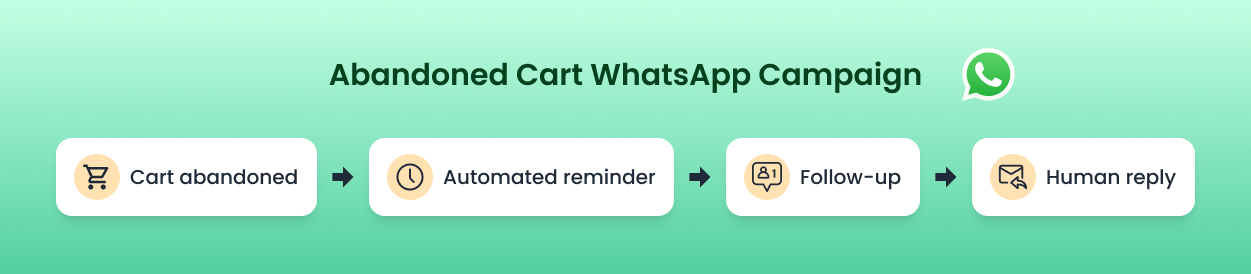
The highest-ROI drip campaign available to any Shopify store. 70–75% of carts are abandoned before checkout. WhatsApp recovery converts at 15–25% for opted-in contacts reached within 60 minutes.
- Message 1 at 30–60 minutes: Friendly reminder, product image, no discount yet
- Message 2 at 24 hours: Soft urgency or small discount for price-sensitive segments
- Message 3 at 48 hours: Final message - social proof or scarcity. Stop after three.
The full sequence with exact timing and template copy is in the WhatsApp abandoned cart recovery guide.
3. Promotional and Flash Sale Campaign (Broadcast)
One message to a segmented subscriber list announcing an offer, new product, or limited-time deal. Keep it to 2–3 sentences with one CTA. Flash sales perform best when the time window is specific "Sale ends at midnight" outperforms "limited time only" because it removes ambiguity and creates measurable urgency.
- Best segment: Customers who purchased in the last 90 days, highest intent, highest trust
- Avoid: Sending promotions to lapsed customers (60+ days inactive) without a re-engagement message first
4. Order Confirmation and Transactional Campaign (Automated)
Consistently the most-opened WhatsApp messages in any ecommerce account near-100% open rates because they carry information the customer actively needs. Include order number, delivery timeline, tracking link, and support contact.
These messages also build brand trust at the highest-intent moment: right after purchase. Adding a subtle cross-sell ("customers who bought X also love Y") in the Day 7 review message, not in the confirmation itself, is the right timing for the upsell.
The complete order confirmation and shipping update setup trigger timing, message formats, and how to configure each notification through Shopify is covered in the WhatsApp order updates guide.
5. Post-Purchase and Retention Campaign (Drip)
Acquiring a new customer costs 5–7x more than retaining an existing one. Post-purchase WhatsApp drip: Day 7 review request, Day 30–45 reorder reminder timed to product lifecycle, Day 60 win-back for inactive customers.
WhatsApp retention campaigns consistently achieve ROAS of 15–60x in ecommerce - higher than most paid acquisition channels. SNOCKS (D2C fashion) and Takko (retail) both built their WhatsApp strategy around retention first, acquisition second. For the broader retention strategy that WhatsApp campaigns sit inside LTV frameworks, channel mix, and what 15–60x ROAS looks like over a full customer lifecycle , the retention marketing guide covers the complete picture.
6. Re-engagement Campaign (Drip)
Customers who have not purchased in 60–90 days need a specific reason to return, not a generic "we miss you." Effective re-engagement messages reference what they previously bought, mention something new since their last visit, and offer a WhatsApp-exclusive incentive.
If the customer does not respond to two re-engagement messages, remove them from broadcast lists. Inactive contacts drag down engagement metrics and raise your opt-out rate which damages sender quality score more than a smaller list does.
7. WhatsApp Flows Campaign (2026 Trend)
WhatsApp Flows let customers complete actions entirely within WhatsApp like browse products, take a style quiz, confirm a COD order, check delivery status, without ever leaving the chat. Completion rates run above 80% and conversion ratios are 158% higher than standard web forms.
For Shopify merchants targeting mobile-first customers in India, Flows remove the biggest friction point in the buying process: the moment a customer has to leave WhatsApp to open a browser tab. Flows require the WhatsApp Business API, not the free app.
For what the API enables across all automations, not just Flows and how to get set up without a developer, the WhatsApp Business API for Shopify guide covers the full setup.
Real WhatsApp Campaign Examples
Four examples: three global brands with documented results, one Indian Shopify store use case. Not projections but actual campaign outcomes.
SNOCKS - WhatsApp as Primary Retention Channel
German D2C fashion brand SNOCKS shifted their retention strategy to WhatsApp as the primary channel over email. They treated opted-in WhatsApp subscribers as a VIP segment that is early access to drops, exclusive offers, and direct communication that email subscribers did not receive.
WhatsApp subscribers consistently showed higher repeat purchase rates than email-only subscribers. The key insight from SNOCKS: subscribers who opt in to WhatsApp self-select as high-intent customers. Their willingness to give a channel access signals they want to hear from you which is why retention campaigns on WhatsApp dramatically outperform email for the same customer.
Takko - Offline to Online via WhatsApp at 37x ROAS
European fashion retailer Takko ran QR codes in physical stores inviting customers to opt into WhatsApp. Opted-in customers received campaigns based on their in-store purchase categories personalised rather than broadcast. The campaign achieved ROAS of 37x, turning a physical store touchpoint into a long-term WhatsApp marketing relationship.
The offline-to-online approach is directly relevant for Indian Shopify brands with physical retail presence. QR codes on packaging, in-store displays, and physical receipts are all viable opt-in collection points that feed into your WhatsApp campaign system.
Amazon India - Transactional and Promotional Split
Amazon India uses separate WhatsApp accounts for transactional messages (OTP, delivery person contact, tracking URL, item code) and promotional messages (deals, offers, product recommendations). This protects the sender quality score on the transactional account if promotional unsubscribes increase, order notification deliverability is unaffected.
For Shopify stores doing significant WhatsApp volume, this structure becomes necessary at scale. Start with one account, but design your automation flows so transactional and promotional messages are logically separated from day one.
WhatsApp Customer Segmentation Strategies
Segmentation is the biggest single variable in WhatsApp campaign performance. Segmented campaigns convert 3–4x better than unsegmented broadcasts and they protect sender quality score by keeping opt-out rates low. Here is how to build segments that actually drive different outcomes.
1. Segment by Purchase History
First-time buyers need reassurance and education. Repeat buyers need early access and rewards. Three-time-plus buyers are your VIPs. Sending a loyalty reward message to a first-time buyer and to a customer who has ordered eight times produces very different engagement if the message does not acknowledge the difference.
2. Segment by Order Type - COD vs Prepaid
COD customers have high purchase intent but also higher return risk, they need a COD confirmation drip immediately after ordering. Prepaid customers have already committed financially, they need post-purchase nurturing, not confirmation. These two segments should never receive the same campaign.
3. Segment by Recency
Customers who purchased in the last 30 days are in an active relationship with your brand. Customers silent for 90+ days should be removed from broadcast lists entirely. They drag down engagement metrics and may trigger sender quality reviews from Meta. Send them one re-engagement campaign, then clean them off if there is no response.
How to Personalise Based on Purchase History
The highest-converting personalisation for Shopify: trigger messages based on specific product categories, not just the customer name. "Hi [name], you ordered the [specific product] last month, here is what other customers who bought it also loved" converts at 3–4x the rate of "Hi [name], we have a sale."
Chatix pulls Shopify order data to enable product-specific personalisation in automated message flows so campaigns reference real purchase history, not generic customer data.
How to Run a WhatsApp Marketing Campaign Step by Step
Six steps from zero to live campaign. If you are starting your first campaign, start with Step 1 and run the abandoned cart drip before any broadcast, it has the clearest trigger, highest intent, and fastest payback.
- Build a compliant opted-in list. Add a WhatsApp consent checkbox at Shopify checkout. Target a 15–25% opt-in rate in the first 30 days. Stores with 40% opt-in rates build 400–600 new WhatsApp contacts per month per 1,000 visitors. Never message anyone who has not explicitly consented.
- Choose your campaign type. Broadcast for announcements and promotions. Drip for cart recovery, onboarding, and retention. Decision: if you want to recover revenue that already existed but was lost, start with drip. If you want to drive new purchase intent, start with broadcast.
- Write the message sequence. 2–4 lines per message, one CTA, one benefit. Follow the 80/20 rule across your campaign calendar: 80% value-driven, 20% promotional. Every promotional message should be preceded by at least 3–4 value-driven messages to protect subscriber trust.
- Set up automation based on Shopify triggers. Connect your WhatsApp platform to Shopify so campaigns fire from real events like cart abandoned, order placed, delivery confirmed, not manual scheduling. Chatix connects directly to Shopify events without developer involvement. See the Shopify WhatsApp integration setup guide for the full setup walkthrough.
- Test with a small segment first. Before sending to your full list, send to 10–15% of the segment and wait 24 hours. Check delivery rate, read rate, and opt-out rate. An opt-out rate above 1% is a signal to fix the message or segment before scaling.
- Measure the right metrics. Open rate on WhatsApp is always high. It is not a performance indicator. Measure conversion rate per campaign, recovered revenue from drips, opt-out rate per message, and campaign ROAS. These four tell you what is actually working.
WhatsApp Festive Campaign Ideas for Indian Shopify Merchants
India's festive calendar creates predictable ecommerce spikes that WhatsApp is uniquely positioned to capture. The key principle: start your WhatsApp campaign 3–5 days before the festival, not on the day. By the day of the festival, most purchase decisions are already made.
| Festival | Timing | Campaign type | Top categories |
|---|---|---|---|
| Diwali | October–November | Broadcast + abandoned cart drip | Gifting, fashion, home décor, jewellery |
| Holi | March | Broadcast | Clothing, colours, FMCG, skincare |
| Eid | Variable | Broadcast | Fashion, food, gifting, accessories |
| Onam | August | Broadcast + retention drip | Fashion, home, food (South India) |
| Navratri / Durga Puja | October | Broadcast | Fashion, jewellery, accessories |
COD tip for festive period: Festive purchases carry higher impulse buying and therefore higher RTO risk. Running a COD confirmation message during festive campaigns "Confirm your Diwali order? Tap Yes to confirm delivery" reduces RTO on the highest-risk order period of the year. The Yes/No quick reply takes 2 seconds for the customer and saves the cost of a returned order.
For the mistakes that get Shopify merchants restricted during high-volume festive periods, see the WhatsApp marketing mistakes guide.
WhatsApp Campaign Performance Metrics
Open rate is always high on WhatsApp. It is not a useful performance metric. These are the six numbers that actually tell you if your campaigns are generating revenue.
| Metric | Healthy Benchmark | Warning sign |
|---|---|---|
| Delivery rate | Above 95% | Contact list has inactive or invalid numbers |
| Read rate (segmented) | 85–95% | Below 70% - timing or message relevance issue |
| Click-through rate - broadcast | 5–15% | Below 5% - CTA or offer is weak |
| Click-through rate - personalised flows | 25–60% | Below 20% - personalisation not working |
| Opt-out rate | Below 0.5% per campaign | Above 1% - frequency or content problem |
| Campaign ROAS | 15–60x | Broadcast |
The 80/20 Rule for WhatsApp Campaign Frequency
Send 1–4 WhatsApp messages per customer per month maximum. Merchants who send weekly lose subscribers faster than they gain them and the ones who leave first are the most engaged customers, because they are the ones paying attention.
The 80/20 rule: for every 5 messages you send, 4 should deliver clear value (tips, order updates, product education, personalised recommendations) and 1 can be promotional. Subscribers who receive value stay subscribed and convert when the promotional message arrives. Subscribers who only receive promotions opt out and take their repeat purchases with them.
Remove contacts who have not opened any message in 90 days from broadcast lists. They are not just inactive, they are actively reducing engagement metrics and potentially triggering quality score reviews from Meta.
Final Thoughts
WhatsApp campaign performance is almost entirely determined by what happens before you send anything the quality of your opt-in list, how tightly you segment it, and whether you are using a broadcast or a drip for the right reasons.
The abandoned cart drip and the COD confirmation are the two campaigns that pay back fastest for any Shopify merchant in India. If you have not set those up yet, everything else can wait. Those two automations, running correctly, fund every other experiment you run on the channel for the next year.
Chatix connects both automations directly to your Shopify store - abandoned cart sequences, COD confirmation, broadcast campaigns, and retention flows all from a single dashboard with no developer involvement.
Frequently Asked Questions
What is a WhatsApp marketing campaign
A WhatsApp marketing campaign is a planned sequence of messages sent to opted-in customers via WhatsApp to achieve a specific goal, promotions, cart recovery, retention, or order updates. Campaigns use either broadcasts (one message to many) or drip sequences (automated messages triggered by customer behaviour).
What is the difference between a WhatsApp broadcast and drip campaign
A broadcast sends one message to multiple contacts simultaneously - best for announcements and promotions. A drip campaign sends a sequence of automated messages over time based on customer actions - best for cart recovery, onboarding, and retention. Use broadcasts to start conversations, drips to continue them.
How often should I send WhatsApp marketing campaigns
1–4 messages per customer per month is the recommended ceiling. Beyond that, opt-out rates spike and sender quality score can drop which restricts your ability to send any messages at all, not just promotional ones.
What is a good conversion rate for a WhatsApp campaign
3–7% for ecommerce campaigns is the broad benchmark. Abandoned cart drips targeting opted-in contacts within 60 minutes consistently achieve 15–25%. Personalised flows with product-specific copy outperform generic broadcasts by 3–4x.
Do I need WhatsApp Business API to run automated drip campaigns
Yes, the free WhatsApp Business App cannot send automated sequences, trigger messages from Shopify events, or broadcast to more than 256 contacts. All automated drip campaigns require the official WhatsApp Business API through an approved Business Solution Provider.
How do I measure WhatsApp campaign success beyond open rates
Track conversion rate per campaign, recovered revenue from drip sequences, opt-out rate per message, and ROAS. Open rates on WhatsApp are always high, the metrics that tell you whether campaigns are actually generating revenue are all downstream of the open.