


WhatsApp Shopify Integration — How to Set It Up and Use It as a Marketing Channel
Shopify + WhatsApp Integration Published: May 05, 2025
WhatsApp Shopify integration is something most Shopify merchants have heard about. A smaller number have set it up. A much smaller number are using it as a marketing channel rather than just a support tool.
The gap between having WhatsApp connected to Shopify and using it to grow revenue is not a technical gap — the setup takes a few hours. It is a strategy gap. This guide covers both: how to connect WhatsApp to Shopify correctly, and how to use it proactively once the integration is live — broadcast campaigns, audience segmentation, opt-in collection, and measuring what returns.
Quick Answer
To connect WhatsApp to Shopify: install a WhatsApp app from the Shopify App Store, connect a dedicated WhatsApp Business number, and enable the WhatsApp Business API for automation. To use WhatsApp as a marketing channel: build an opted-in customer list at Shopify checkout, segment that list by purchase behaviour, and run planned broadcast campaigns — product launches, seasonal promotions, upsell sequences, and re-engagement messages. The setup takes a few hours. The marketing strategy on top of it is what separates stores using WhatsApp for support from stores using it to grow revenue.
Key Takeaways
- WhatsApp Shopify integration and WhatsApp marketing on Shopify are two different things — integration is the setup, marketing is what you do with it once it is live
- Opt-in collection at Shopify checkout is the foundation of everything — without opted-in contacts, broadcast campaigns cannot go out legally or effectively
- Audience segmentation by Shopify purchase data is what separates relevant WhatsApp marketing from messages customers block
- Broadcast campaigns, seasonal promotions, post-purchase upsell sequences, and re-engagement messages are the four campaign types that generate the most WhatsApp marketing revenue for Shopify stores
- Open rate, click-through rate, reply rate, and campaign revenue are the four metrics that tell you whether your WhatsApp marketing is working — not message volume
What Most Shopify Stores Get Wrong About WhatsApp?
The most common version of WhatsApp on a Shopify store is a floating chat button that answers customer questions and sends order updates automatically. That is the reactive version — WhatsApp as a support and notification channel.
It works. Customers get their questions answered faster. Support ticket volume drops. Order anxiety reduces because updates arrive without customers having to chase them. But none of that is marketing. Marketing is proactive — reaching customers with the right message at the right moment based on what they have bought, what they have browsed, and where they are in the customer lifecycle.
1. Reactive WhatsApp vs Proactive WhatsApp — The Revenue Gap
Reactive WhatsApp: a customer messages you, you reply. An order ships, an automated notification goes out. A cart is abandoned, a recovery message fires. These are responses to customer actions — the customer initiates or an event triggers the message.
Proactive WhatsApp: you initiate contact based on a marketing decision — a product launch, a seasonal sale, a segment of customers who bought from a specific category three months ago. The customer did not take an action that triggered the message. You decided to reach them because of who they are in your store's customer data.
The revenue gap between the two is significant. Stores running only reactive WhatsApp are recovering abandoned carts and reducing support load. Stores running proactive WhatsApp campaigns on top of automation are generating additional revenue from broadcasts, driving repeat purchases from lapsed segments, and using WhatsApp as a primary sales channel for new product launches. The setup is the same. The marketing layer on top is what creates the difference. The five reactive automation flows and how to set them up are covered in the WhatsApp automation for Shopify guide.
How to Connect WhatsApp to Your Shopify Store?
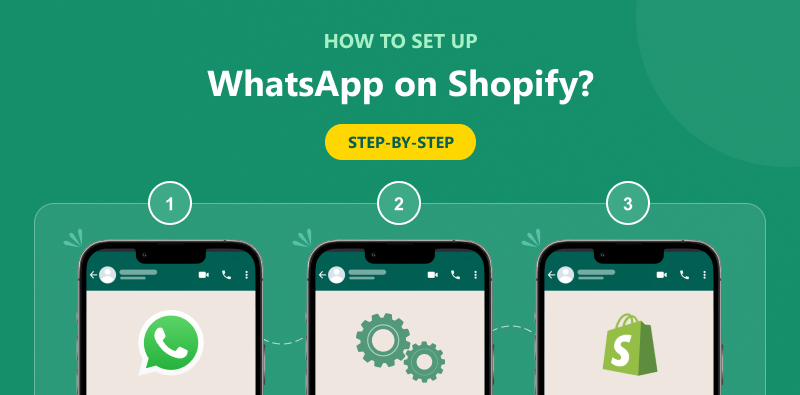 This section covers the setup decisions every Shopify merchant needs to make before WhatsApp marketing can run. For the detailed step-by-step on widget placement, chat button setup, and pre-purchase integration, the WhatsApp integration with website guide covers that in full. For the full automation flow setup — abandoned cart, COD verification, order updates — the WhatsApp automation for Shopify guide covers all five flows. This section focuses on the marketing-specific setup decisions.
What You Need Before You Start
Three things are required before any WhatsApp marketing can go out from a Shopify store:
- A dedicated WhatsApp Business number: not linked to a personal WhatsApp account. This becomes the number your customers receive marketing messages from. Using a personal number means one person controls access, conversations are not shared, and migrating later is complicated.
- A verified Meta Business Manager account: required for WhatsApp Business API access. Without it, broadcast campaigns, template messages, and automation cannot run. Verification takes 1–3 business days in most markets.
- WhatsApp Business API access: the standard WhatsApp Business App does not support broadcast campaigns to opted-in customer lists, message templates for marketing, or automation triggered by Shopify events. The API is required for all of those. The full application process and what Shopify merchants need before applying is covered in the WhatsApp Business API for Shopify guide
How to Add WhatsApp Opt-In at Shopify Checkout?
An opted-in customer list is the foundation of WhatsApp marketing on Shopify. Without it, broadcast campaigns either cannot go out or violate Meta's terms of service — both outcomes waste the setup investment.
The most effective opt-in collection point on a Shopify store is the checkout page. A checkbox at checkout — placed between the contact details and the payment section — asking customers to consent to receiving WhatsApp updates and offers converts at a higher rate than any other opt-in placement because the customer is already engaged and already inputting their phone number.
The checkbox copy matters. Vague language like 'I agree to receive WhatsApp messages' converts lower than specific language like 'Send me my order updates and exclusive offers on WhatsApp.' Customers opt in to things that sound useful, not to legal-sounding permissions.
Additional opt-in collection points: a WhatsApp opt-in popup triggered after a customer has been on a product page for 30 seconds, a checkout confirmation page opt-in for customers who didn't check the box, and a post-purchase email with a WhatsApp opt-in link for customers whose orders have shipped.
How to Set Up WhatsApp for Marketing on Shopify?
1_17726939870.png) Once the API is live and opt-in collection is configured, the marketing setup involves three steps: install a Shopify WhatsApp automation app that connects the API to your store and manages campaigns, get your message templates approved by Meta before your first broadcast (approval takes minutes to a few hours), and connect your Shopify customer segments to your WhatsApp contact lists so campaigns can be targeted by purchase behaviour rather than sent to your entire list.
Once the API is live and opt-in collection is configured, the marketing setup involves three steps: install a Shopify WhatsApp automation app that connects the API to your store and manages campaigns, get your message templates approved by Meta before your first broadcast (approval takes minutes to a few hours), and connect your Shopify customer segments to your WhatsApp contact lists so campaigns can be targeted by purchase behaviour rather than sent to your entire list.
For a comparison of the Shopify WhatsApp apps that handle this setup, the best WhatsApp automation tools guide covers the options in detail.
Chatix connects the WhatsApp Business API to your Shopify store and handles opt-in collection, template management, campaign scheduling, and audience segmentation from one dashboard. For detailed setup of the chat widget and WhatsApp button on your Shopify store, the WhatsApp integration with website guide covers placement, welcome messages, and testing
The 4 WhatsApp Marketing Campaigns Every Shopify Store Should Run
WhatsApp marketing campaigns are distinct from automation flows. Flows are triggered by customer actions — a cart abandonment, an order placement. Campaigns are planned broadcasts sent to a defined segment at a chosen time. Both run simultaneously — automation handles the reactive layer, campaigns handle the proactive layer. The WhatsApp marketing campaigns ecommerce guide covers the broader strategy framework.
1. Broadcast Campaigns — Product Launches and Promotions
A broadcast campaign sends the same WhatsApp message to a defined segment of opted-in customers at a scheduled time. For Shopify stores, the most common and highest-returning broadcast campaigns are product launches and limited-time promotions.
Product launch broadcasts work because WhatsApp reaches customers within minutes — not hours. A new product announcement sent to customers who previously bought from the same category lands while the product is new and inventory is full. The same announcement sent by email reaches most recipients 6–8 hours later, by which time early buyers have already created social proof that drives organic discovery.
Promotion broadcasts work best when sent to a specific segment rather than the entire opted-in list. A discount on women's clothing sent to customers who have bought from the women's category in the last 90 days outperforms the same discount sent to every opted-in customer. The relevance signal is what drives the conversion — and what keeps customers from opting out.
Timing matters for broadcast campaigns. Mid-morning (10–11 AM) and early evening (7–8 PM) in the customer's time zone consistently outperform other send times for Shopify stores. Avoid late night sends — messages that arrive after 10 PM get lower engagement and higher opt-out rates.
The WhatsApp message templates library has Meta-approved broadcast templates for product launches, limited-time offers, and flash sales — ready to customise and send without writing from scratch.
2. Seasonal and Festival Campaigns
Seasonal campaigns are the highest-volume WhatsApp sends of the year for Shopify stores serving Indian, Middle Eastern, and Southeast Asian markets — Diwali, Eid, BFCM, Christmas, and New Year collectively account for a disproportionate share of annual WhatsApp marketing revenue for stores in these markets.
The mistake most Shopify stores make with seasonal campaigns is sending them too late — a Diwali campaign sent 2 days before Diwali is competing with every other brand sending at the same time. A Diwali campaign sent 10–14 days before gives customers time to browse, consider, and purchase before the holiday rush. The early send also lands before competitors, which means your message gets attention rather than getting lost.
WhatsApp Flows — Meta's in-chat interactive feature introduced in 2025 — makes seasonal campaigns significantly more effective for Shopify stores that have activated them. A WhatsApp Flow allows a customer to browse a curated product selection, select items, and complete checkout directly inside WhatsApp without being redirected to your store. For high-intent seasonal buyers who are ready to purchase, removing the redirect step reduces friction and increases conversion. Flows require API access and template approval — factor this into campaign planning at least two weeks before the seasonal send. Ready-to-use WhatsApp offer message templates for Diwali, BFCM, Eid, and other seasonal campaigns are available in the templates library — pre-approved formats that factor in the timing and tone that convert.
3. Post-Purchase Upsell Sequences
The window between delivery confirmation and the customer's next purchase decision is the highest-intent moment for an upsell on WhatsApp. A customer who just received a product they are satisfied with is more open to a complementary product recommendation than at any other point in the customer journey.
A post-purchase upsell sequence on WhatsApp is not an automation flow — it is a planned campaign sent to a segment of customers whose orders were marked delivered in a specific time window. Sent 3 to 5 days after delivery, it references what the customer bought and recommends something specific and complementary — not the store's bestseller list.
A customer who bought a skincare serum gets a recommendation for the moisturiser that pairs with it — not a generic 'you might also like' carousel. A customer who bought a pair of running shoes gets a recommendation for the socks or insoles that improve the experience — not the store's latest apparel drop. The specificity of the recommendation is what makes the message feel like advice rather than advertising.
4. Re-Engagement Broadcasts for Lapsed Customers
A lapsed customer segment — customers who purchased once or twice but have not returned within a defined window — is one of the most valuable audiences for a WhatsApp broadcast campaign. They already know the store, they have already completed a purchase, and the barrier to a second purchase is lower than the barrier to a first.
The right re-engagement window depends on your store's natural repurchase cycle. A store selling consumable products (skincare, supplements, coffee) should define 'lapsed' at 60 to 90 days — roughly when the product runs out. A store selling fashion should define it at 90 to 120 days. A store selling high-consideration products (electronics, furniture) should define it at 180 days or more.
The re-engagement message should reference the previous purchase category, not the specific product. A customer who bought from your skincare range gets a message about new arrivals in skincare — not a 'we miss you' generic broadcast. The category reference signals that the message is relevant without requiring the customer to remember exactly what they bought.
How to Build Your WhatsApp Audience on Shopify?
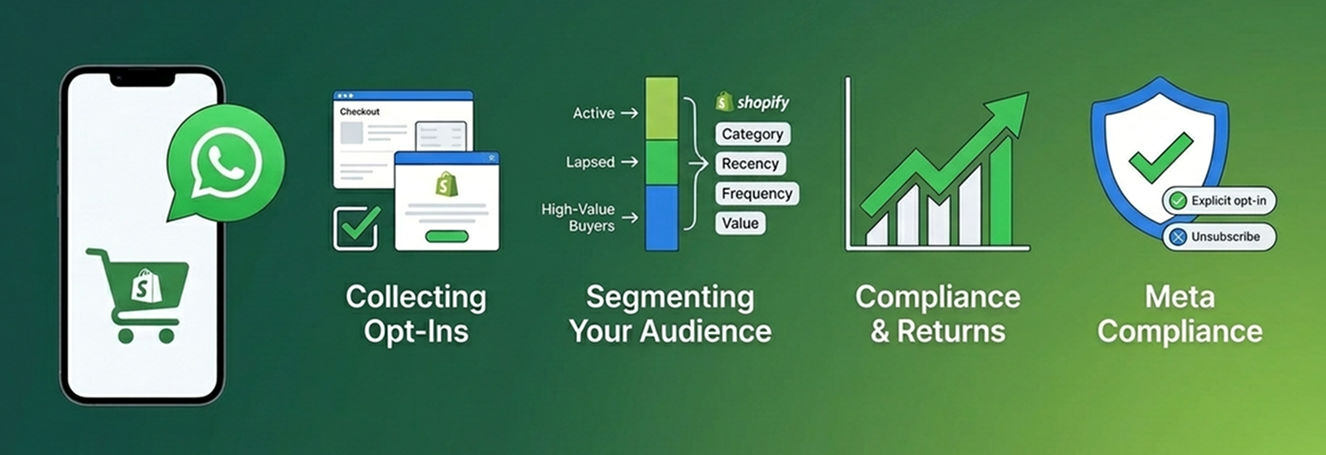
1. Collecting Opt-Ins — Where and How
The quality of a WhatsApp marketing list is more important than its size. A list of 1,000 customers who actively opted in converts better than a list of 10,000 imported contacts who did not. WhatsApp's quality scoring system penalises senders whose messages get blocked or reported — a low-quality list that generates blocks will restrict your number's sending capability before the campaign delivers meaningful returns.
The four most effective opt-in collection points for Shopify stores in order of conversion rate: checkout page checkbox, post-purchase page opt-in, product page popup triggered after 30 seconds of engagement, and order confirmation email with a WhatsApp opt-in link. Most stores start with the checkout checkbox and add the others as the list grows.
Never import existing customer phone numbers without a specific WhatsApp consent record. A customer who gave their phone number at checkout for order updates has not consented to WhatsApp marketing messages. The consent must be specific to WhatsApp and specific to the type of messages they will receive.
2. Segmenting Your WhatsApp Audience by Shopify Data
Segmentation is what makes WhatsApp marketing relevant rather than intrusive. A store with 5,000 opted-in customers sending every campaign to the full list will see declining engagement, rising opt-outs, and a deteriorating quality score over time. The same store sending each campaign to the 500 to 1,000 customers for whom it is specifically relevant will see higher engagement and lower opt-out rates.
The Shopify data points that matter most for WhatsApp segmentation: purchase category (what they have bought from), purchase recency (how recently they bought), purchase frequency (how many times they have bought), average order value (how much they typically spend), and location (for market-specific seasonal campaigns). Chatix surfaces these data points directly inside the campaign builder so segmentation is practical without a technical resource.
Start with three segments: active buyers (purchased in the last 60 days), lapsed buyers (last purchase 60 to 180 days ago), and high-value buyers (top 20% by order value). Run different campaigns for each. Track which segment converts at the highest rate for each campaign type. Refine the segmentation based on the data.
3. WhatsApp Opt-In Compliance for Shopify Merchants
WhatsApp marketing is legal and effective when customers have explicitly opted in. It becomes a compliance risk — and a number ban risk — when messages go to contacts who did not consent.
Meta's requirements for WhatsApp marketing compliance: explicit opt-in from each contact before the first marketing message, a clear opt-out mechanism in every broadcast message (a reply keyword like STOP or an unsubscribe link), processing opt-outs within 24 hours, and using only pre-approved message templates for outbound marketing messages. Templates that misrepresent the sender, use deceptive urgency language, or promote prohibited content categories will not be approved.
For stores serving European customers, GDPR adds an additional layer of compliance requirements — the opt-in record must include what the customer consented to, when they consented, and how. This is a data record your Shopify WhatsApp app should maintain automatically. If it does not, the compliance burden falls on your team.
A quality score above 70 in your WhatsApp Business Manager is the signal that your marketing practices are compliant. A score below 70 indicates your messages are being blocked or reported at a rate that will restrict sending capability. Monitor it weekly during active campaign periods.
How to Measure WhatsApp Marketing Performance on Shopify?
The 4 Metrics That Matter for WhatsApp Marketing
The 4 Metrics That Matter for WhatsApp Marketing
Message volume and list size are not performance metrics — they are inputs. The metrics that tell you whether WhatsApp marketing is working are open rate, click-through rate, reply rate, and campaign revenue.
| Metric | What It Measures | Where to Find It | Benchmark |
|---|---|---|---|
| Open rate | How many recipients opened the message | WhatsApp analytics in your app dashboard | Above 90% |
| Click-through rate | How many clicked a link inside the message | Campaign report in your automation app | 15–30% for broadcast campaigns |
| Reply rate | How many customers replied to the message | Conversation data in your team inbox | 5–15% depending on message type |
| Campaign revenue | Revenue directly attributed to a WhatsApp campaign | UTM tracking via Shopify analytics | Varies by campaign type and audience size |
Benchmark for Shopify Stores
WhatsApp open rates consistently run above 90% for opted-in audiences. If your open rate drops below 85%, the most common causes are list quality (contacts who opted in passively and are not engaged), message timing (sends outside the 10 AM to 9 PM window in the recipient's time zone), or template quality (messages that do not clearly identify your brand or the reason for contact).
Click-through rates for WhatsApp broadcast campaigns vary by campaign type. Product launch broadcasts to a relevant segment typically see 20–35% CTR. Re-engagement broadcasts to lapsed customers typically see 10–20% CTR. Seasonal promotion broadcasts vary widely depending on the offer and segment relevance.
Reply rates are the metric most unique to WhatsApp versus email — a 5–15% reply rate on a broadcast campaign means real conversations are starting. Those conversations are where WhatsApp marketing generates revenue that attribution models often miss — a customer who replies to a product launch campaign, asks a question, and completes a purchase via a link sent in the reply is recorded as a direct session in Shopify analytics, not as a WhatsApp campaign conversion.
Track campaign revenue by adding UTM parameters to every link in every WhatsApp broadcast campaign. In Shopify Analytics, filter by the UTM source and campaign to isolate WhatsApp-attributed revenue. This is the number that tells you whether WhatsApp marketing is worth the investment — not open rate or list size.
What Good WhatsApp Marketing Looks Like vs What Gets Numbers Flagged
Message Frequency — How Often Is Too Often
There is no universal rule on WhatsApp message frequency — but there is a practical guideline that holds across most Shopify store categories: no more than 4 to 6 broadcast messages per month to any individual customer. Above that threshold, opt-out rates rise consistently, regardless of message quality.
The frequency rule applies per customer, not per campaign. If a customer is in three different segments — active buyers, high-value buyers, and women's category buyers — and each segment receives one campaign per month, that customer receives three messages. That is within the acceptable range. If each segment receives two campaigns per month, that customer receives six messages. Monitor opt-out rates by segment — a segment showing opt-out rates above 5% is receiving too many messages or messages that are not relevant enough to justify the frequency.
Automation flows do not count toward marketing message frequency — they are triggered by customer actions and are expected by customers who initiated the trigger (placing an order, abandoning a cart). The frequency rule applies to planned broadcast campaigns only.
What WhatsApp Allows and What It Doesn't?
WhatsApp prohibits sending marketing messages to contacts who have not explicitly opted in, using unofficial third-party tools that bypass the API (these risk permanent number bans), sending messages that misrepresent the sender's identity, promoting prohibited content categories (gambling, adult content, counterfeit goods, financial products without proper licensing), and using purchased or scraped contact lists.
Meta banned third-party AI chatbots from the WhatsApp platform in October 2025. Business-specific AI — your own trained assistant responding to customers — remains permitted. Generic third-party chatbots that are not specific to your business are no longer compliant. If your WhatsApp setup uses a third-party chatbot tool, verify that it has updated its approach to comply with this change before running campaigns.
What WhatsApp actively rewards with higher delivery rates and better quality scores: messages that get replies, messages that do not get blocked, messages sent to opted-in audiences using approved templates, and consistent sending patterns rather than sudden volume spikes. Building a WhatsApp marketing system that generates conversations rather than one that blasts messages is both the ethical approach and the technically correct one for sustained delivery performance.
Final Thoughts
WhatsApp Shopify integration is a two-layer setup. The first layer is technical — connecting the API, installing the app, adding the chat widget, and activating automation flows. That layer takes a few hours and is covered in detail across the dedicated posts this guide links to.
The second layer is marketing — building an opted-in audience, segmenting it by Shopify purchase data, running planned campaigns at the right moments, and measuring what returns. That layer is what most Shopify stores skip. It is also where the revenue difference between stores using WhatsApp and stores growing through WhatsApp actually comes from.
Chatix connects the WhatsApp Business API to your Shopify store and handles both layers — automation flows, chat widget, team inbox, opt-in collection, broadcast campaigns, and audience segmentation — from one dashboard, starting from a free plan.
Frequently Asked Questions
1. How do I integrate WhatsApp with Shopify?
Ans: Install a WhatsApp app from the Shopify App Store, connect a dedicated WhatsApp Business number, and enable the WhatsApp Business API. The app handles the connection to Shopify — no coding required.
2. Do I need the WhatsApp Business API for Shopify marketing?
Ans: Yes. The standard WhatsApp Business App does not support broadcast campaigns, message templates for marketing, or automation triggered by Shopify events. The API is required for all three.
3. How do I collect WhatsApp opt-ins from Shopify customers?
Ans: Add a checkbox at Shopify checkout asking customers to consent to WhatsApp updates and offers. This is the highest-converting opt-in placement. Add a post-purchase page opt-in and a product page popup as secondary collection points.
4. Can I send broadcast campaigns to all my Shopify customers on WhatsApp?
Ans: Only to customers who have explicitly opted in to receive WhatsApp marketing messages. Sending to customers who gave their phone number for order updates but did not opt in to marketing violates Meta's terms of service.
5. How do I know if my WhatsApp marketing is working?
Ans: Track open rate, click-through rate, reply rate, and campaign revenue using UTM parameters on every broadcast link. Open rate above 90% and click-through above 15% indicate the campaigns are performing correctly.