



How to Choose the Best WhatsApp Live Chat Tool for Your Business?
How-to Guides Published: November 19, 2025
Most Shopify merchants don't struggle with finding a WhatsApp live chat tool. They struggle with picking one that actually works with how their store operates — and realising too late that a long feature list doesn't mean it fits their workflow.
If you've landed here, you already know WhatsApp live chat is worth having. From product recommendations to post-purchase support, WhatsApp Live Chat bridges the gap between your store and your customers in real time. What you need now is clarity on what separates a tool that genuinely helps your Shopify store from one that looks impressive in a comparison table but creates more work than it solves.
But with so many tools offering WhatsApp chat integration, finding the right one can feel confusing.This guide is for Shopify store owners who are ready to choose — not just browse. By the end, you'll know exactly what to look for, what questions to ask, and how to avoid the most common and costly mistakes.
Quick Answer
The best WhatsApp live chat tool for a Shopify store is one that integrates directly with Shopify, supports your team's workflow without a steep learning curve, and does more than just open a chat window — it should help you recover carts, confirm orders, and support customers from one place.
Key Takeaways
- Most tools look similar on paper — the real difference shows up in day-to-day Shopify use
- Multi-agent support, automation, and Shopify-native integration are the three non-negotiables
- A tool that's hard to set up or train your team on will get abandoned within weeks
- The right tool should reduce your support workload, not add to it
Why Most WhatsApp Live Chat Tools Fail Shopify Stores After the First Week?
Here's something most comparison blogs won't tell you — the majority of WhatsApp live chat tools are built for generic business use, not specifically for Shopify. They work fine as a basic chat button. But the moment you need them to do anything meaningful — pull order details, trigger cart recovery messages, or let two support agents handle chats without stepping on each other — they fall short.
The failure usually happens quietly. The tool gets installed, looks great on the storefront, and then the team realises they're still manually copying order numbers into WhatsApp, still chasing abandoned carts by hand, and still switching between five tabs to answer one customer question.
That's the execution gap. And it's not a feature problem — it's a fit problem. If you haven't set up WhatsApp live chat yet, this guide on how to add WhatsApp live chat to your Shopify store covers what a proper installation looks like before you start comparing tools.
Ask yourself this before evaluating any tool: Does this tool work the way my Shopify store actually works — or does it need my store to adapt to it?
The Features That Actually Matter for a Shopify Store
Not every feature on a tool's pricing page will move the needle for your store. Here's what genuinely matters versus what sounds good but rarely gets used.
Features that actually matter:
- Shopify-native integration: The tool should connect directly to your Shopify store — not through a workaround. This means it can access order data, customer history, and cart information without manual input.
- Multi-agent shared inbox: If more than one person handles customer queries, you need a shared team inbox. Without it, messages get missed, duplicated, or answered twice.
- Automated messages tied to Shopify triggers: Abandoned cart recovery, order confirmation, COD verification, and shipping updates should fire automatically based on Shopify events — not require manual sending every time.
- WhatsApp Business API support: For stores with consistent order volume, the API is essential. It unlocks broadcast messaging, template messages, and proper automation at scale. Browse the WhatsApp message templates library to see what approved templates look like in practice.
- Mobile app access: Your team shouldn't be tied to a desktop. Mobile access keeps response times fast even outside office hours.
Features that look good but rarely matter:
- Unlimited integrations with tools you don't use
- AI chatbot features that need weeks of training to be useful
- Analytics dashboards that go unchecked after the first month
A note on WhatsApp compliance Any tool using the WhatsApp Business API must operate within Meta's approved messaging guidelines. This means customers need to opt in before receiving automated messages — promotional broadcasts cannot be sent to cold contacts. Always check that the tool you choose handles opt-in compliance properly. Non-compliant sending can result in your WhatsApp number being restricted.
Tools like Chatix are built specifically for Shopify — meaning the features above come ready to use, and API compliance is handled within the platform rather than left to you to figure out separately.
Questions You Should Ask Before Installing Any WhatsApp Chat Tool
Most merchants compare tools by looking at feature lists side by side. That's a starting point — but it misses the questions that actually reveal whether a tool will work for your specific store.
- How does it connect to Shopify?: Is it a native Shopify app or a third-party embed? Native apps are faster to set up and more stable long term.
- What happens when multiple agents are online?: Can agents see who is handling which conversation, or will customers get two different replies?
- How are automated messages triggered?: Are triggers based on real Shopify events like checkout abandonment and order fulfilment, or does every message require manual setup?
- What does the setup actually look like?: Ask for a demo or check recent reviews specifically about onboarding. A tool that takes days to configure will slow your team down before it helps them.
- What happens when something goes wrong?: If something breaks on a peak sales day, is there live support available or just a help doc? That's the real question.
These questions cut through the marketing and get to whether the tool fits how you actually run your store. The WhatsApp Shopify Integration guide covers what a proper setup looks like before you commit to any tool.
Common Mistakes Shopify Merchants Make When Choosing a Live Chat Tool
Even merchants who do their research make these mistakes. Being aware of them upfront saves time, money, and frustration.
1. Choosing based on price alone. A free or cheap tool might handle basic chats but won't support automation, team inboxes, or API-level messaging. The cost of missed carts and slow responses adds up faster than a monthly subscription.
2. Ignoring how the team will actually use it. A tool your support team finds confusing will get abandoned. Ease of use matters as much as functionality — especially for small teams with no dedicated technical person.
3. Not testing Shopify compatibility properly. Some tools claim Shopify integration but only offer a chat button embed. That's not integration — that's a widget. Real integration means order data, customer history, and automation triggers all work natively. If you're unsure what real integration looks like versus a basic widget, this explainer on how WhatsApp chat works on your website is worth a quick read
4. Skipping the automation check. Many merchants install a live chat tool thinking they'll set up automation later. Later rarely comes. Choose a tool where automation is straightforward to configure from day one.
5. Overlooking scalability. A tool that works fine at 50 orders a month may struggle at 500. Make sure your choice can grow with your store without requiring a full migration later.
The WhatsApp automation for Shopify guide covers what a proper automated setup looks like in practice — worth reading before you decide.
How to Evaluate to Know You've Found the Right Fit?
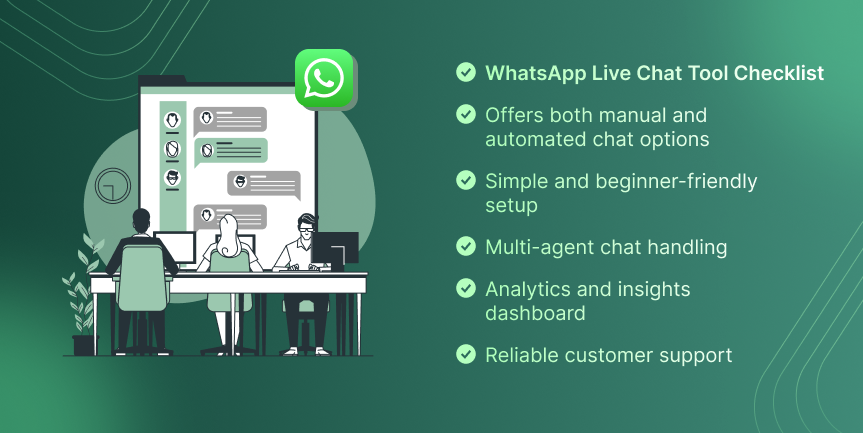
Once you've shortlisted a tool, run it through this final check:
- Connects to Shopify without a workaround: Setup takes minutes, not days, and your existing store data is accessible immediately.
- Your team can use it on day one: The interface is clean, the inbox is easy to navigate, and there's no steep learning curve for agents who aren't technical.
- Automation works out of the box: Cart recovery, order confirmation, and COD verification can be switched on without needing a developer.
- Support is reachable and responsive: Check recent reviews. If merchants mention slow support or unresolved bugs, take that seriously — especially around high-traffic periods like sales events.
- Pricing makes sense at your current volume and your next stage: Don't choose a tool that's right for where you are now but forces you to migrate when you scale.
If a tool clears all five — it's the right fit. You can also check out 7 tips for using WhatsApp for customer support to get the most from it once you're set up.
Conclusion
Choosing the right WhatsApp live chat tool comes down to one thing — fit. Not the longest feature list, not the cheapest price, not the prettiest interface. The tool that works is the one that slots into your Shopify store's workflow without friction and actually gets used by your team every day.
If you're already planning to add WhatsApp live chat to your Shopify store, Chatix is built specifically for that — Shopify-native, easy to set up, and ready to handle everything from live chat to automated order messages from day one.
Frequently Asked Questions
1. What is the best WhatsApp live chat tool for Shopify stores?
Ans: The best tool is one that integrates natively with Shopify, supports team inboxes for multiple agents, and automates key messages like abandoned cart recovery and order confirmations. Chatix is built specifically for Shopify and covers all of these without requiring technical setup.
2. Do I need the WhatsApp Business API to use live chat on my Shopify store?
Ans: Not necessarily for basic chat — but for automation, broadcast messages, and handling high order volumes, the API is essential. Most growing Shopify stores benefit from moving to API-level tools as they scale.
3. How long does it take to set up WhatsApp live chat on Shopify?
Ans: With a native Shopify app, setup typically takes under 30 minutes. You install the app, connect your WhatsApp number, customise the chat widget, and go live. Automation like cart recovery messages may take slightly longer to configure but doesn't require technical knowledge.
4. Can multiple team members manage WhatsApp chats at the same time?
Ans: Yes — but only if the tool supports a shared team inbox. Without it, multiple agents end up in separate conversations with no visibility over who has responded to what. Always confirm this before choosing a tool.
5. Is WhatsApp live chat better than email for Shopify customer support?
Ans: For response speed and open rates, yes. WhatsApp messages are read significantly faster than emails and feel more personal to customers. For formal communication, email still has its place — but for real-time queries, cart recovery, and order updates, WhatsApp outperforms email consistently.