


How to Send 1000 Messages at Once on WhatsApp — Without Getting Your Number Banned
How-to Guides Published: March 18, 2024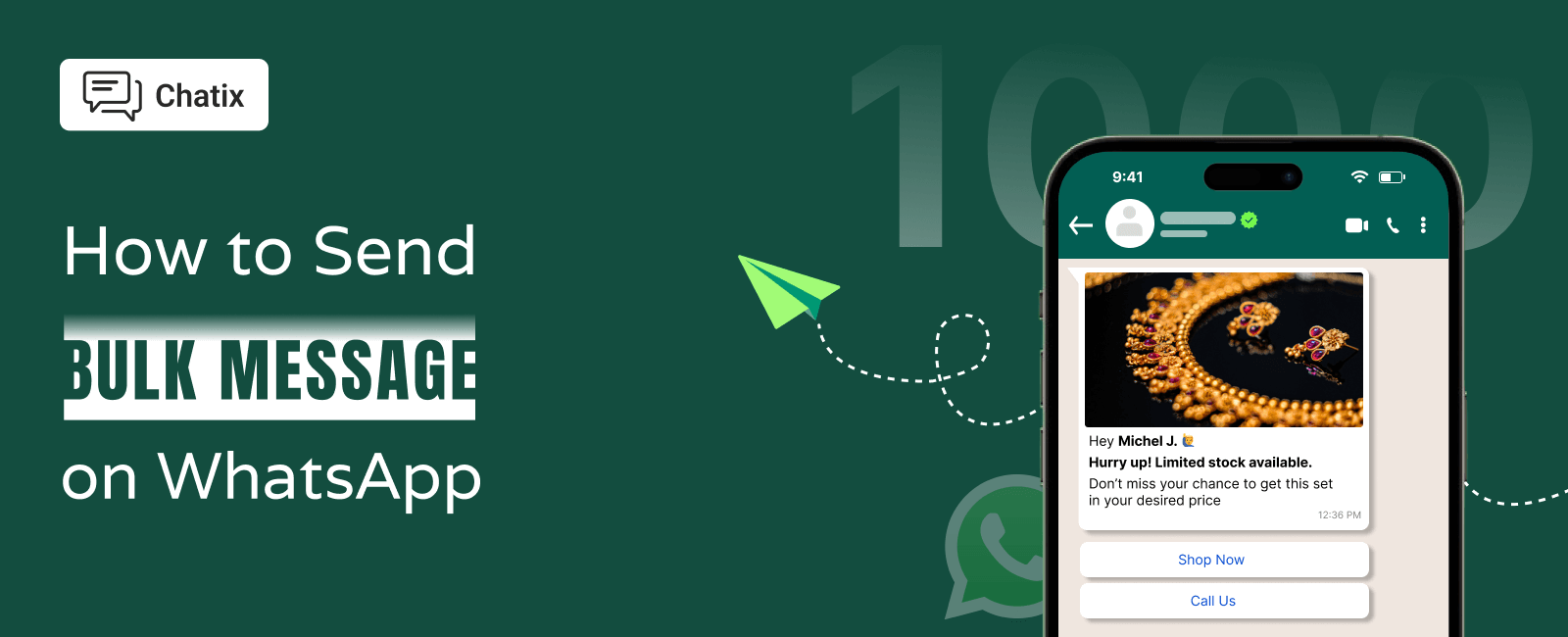
Sending 1,000 WhatsApp messages at once sounds simple until you try it. The 256-contact broadcast limit hits immediately. Third-party bulk tools promise unlimited sends but come with a hidden cost — your number gets flagged, restricted, or permanently banned within days.
For Shopify merchants wanting to announce a sale, launch a product, or reach their full customer list at once, the right method makes the difference between a successful campaign and a banned account.
This guide covers all three methods honestly — what each one does, what it can't do, and where each one breaks down. If you want to reach 1,000, 10,000, or more WhatsApp contacts without risking your number, this is the guide.
Quick Answer
The only safe way to send 1,000+ WhatsApp messages at once is through the WhatsApp Business API. Broadcast lists are capped at 256 contacts. The WhatsApp Business App has the same limit. Unofficial third-party tools bypass the limit but violate WhatsApp's terms and risk permanent bans. The API has no contact ceiling, supports automation and personalisation, and is fully compliant — but requires opted-in contacts and uses pre-approved message templates.
Key Takeaways
- WhatsApp broadcast lists are capped at 256 contacts per list — to reach 1,000 people you'd need four separate lists sent manually
- The WhatsApp Business App has the same 256-contact ceiling — it adds useful features but not bulk sending capability
- Unofficial bulk messaging tools bypass limits but violate WhatsApp's terms and commonly result in permanent number bans
- The WhatsApp Business API is the only method that safely sends 1,000+ messages at once with no contact ceiling
- Shopify merchants use API-connected tools like Chatix to send bulk campaigns tied directly to store data and customer segments
Why WhatsApp Bulk Messaging Fails?
1. The WhatsApp 256-Contact Limit and Why It Exists
WhatsApp's 256-contact broadcast limit exists because of spam prevention — not arbitrary product design. When WhatsApp sees an account sending the same message to a large number of contacts in a short period, it reads that as potential spam behaviour. Unofficial bulk messaging tools work by simulating a human sending messages very fast — which is precisely the pattern WhatsApp's detection system flags. The contact limit gets bypassed. The spam signal gets triggered. The number gets restricted.
2. Why Your WhatsApp Broadcasts May Not Be Reaching Everyone
Even within the 256-contact limit, broadcast messages only reach contacts who have your number saved on their phone. If you've collected phone numbers through a Shopify checkout form, a website widget, or a marketing database, a large percentage haven't saved your number — meaning your broadcast doesn't reach them regardless of method. This is why many merchants report sending 500 messages but only 200 being delivered. The method isn't broken — the audience isn't properly opted in.
3. What Shopify Merchants Do Instead?
The Shopify stores sending 10,000 WhatsApp messages a day without restrictions aren't using workarounds. They're using the WhatsApp Business API with a properly built opt-in audience — customers who asked to receive messages and whose numbers don't need to be saved on anyone's phone. That's the baseline to build toward.
Before moving to the API, it's worth understanding exactly how broadcasts behave versus group messages — the WhatsApp Broadcast vs Groups guide covers the distinction clearly, including how privacy, replies, and delivery work differently in each.
1. What are WhatsApp Broadcast Lists
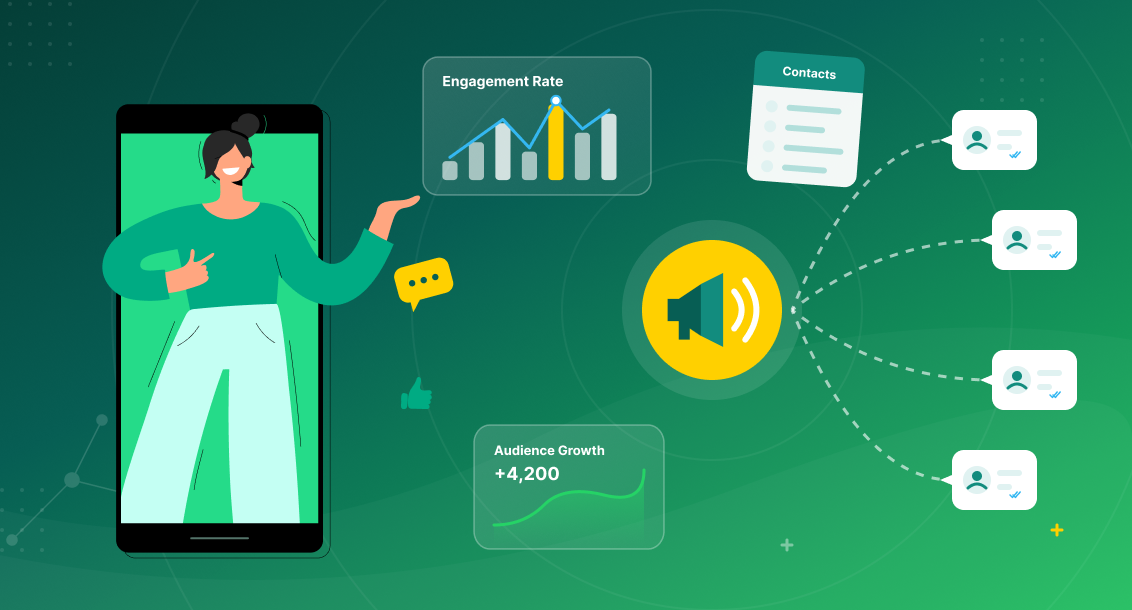
WhatsApp broadcast lists are the built-in way to send the same message to multiple contacts at once. Every contact receives it as an individual private message — they can't see who else received it.
What WhatsApp Broadcast Lists Can Do?
Create a broadcast list, add up to 256 contacts, write your message and send. No additional tools, no cost, no API required. The message appears in each recipient's personal chat as if you sent it directly to them.
What WhatsApp Broadcast Lists Cannot Do?
- Send to more than 256 contacts per list
- Reach contacts who haven't saved your number
- Schedule messages to send at a future time
- Personalise messages with dynamic variables like customer names or order details
- Track delivery rates, click rates, or any campaign performance metrics
- Run automated sequences triggered by Shopify order or customer events
Who Should Use WhatsApp Broadcast Lists?
For small businesses with under 200 opted-in customers who all have your number saved, broadcast lists work fine. They're free, simple, and require no technical setup. For any Shopify store approaching meaningful order volume — or any campaign needing personalisation, scheduling, or performance data — broadcast lists are not fit for purpose.
How to Create a WhatsApp Broadcast List on Android and iPhone?
- On Android — open WhatsApp, tap the three-dot menu, select New Broadcast, add your contacts (up to 256), tap the checkmark, write your message and send.
- On iPhone — open WhatsApp, go to Chats, tap Broadcast Lists in the top-left corner, tap New List, add contacts, tap Create, write your message and send.
Your list is saved and reusable — no need to rebuild it every time you want to message the same group. For templates, compliance tips, and best practices, the How to Send Broadcast Messages on WhatsApp guide covers everything in detail.
2. Messaging through WhatsApp Business App
The WhatsApp Business App gives you a professional business profile, product catalog, quick replies, and basic automation — but for bulk messaging, the core limit is unchanged.
1. WhatsApp Business App Features for Bulk Messaging
- A verified business profile with your name, description, and working hours
- Quick reply templates for frequently sent messages
- Away messages and greeting messages for basic automation
- Labels to organise contacts by customer type or purchase stage
2. WhatsApp Business App — Is It Right for Shopify Stores?
The WhatsApp Business App is where most Shopify merchants should start — it's free, it's legitimate, and the profile and catalog features are genuinely useful. But the broadcast ceiling is still 256 contacts per list, there is no scheduling, no automation triggered by Shopify events, and no analytics beyond basic delivery ticks. If your goal is sending 1,000+ messages at once, the Business App gets you no closer than the standard app. It's a better tool for the same limit — not a step toward bulk messaging.
While the Business App won't solve the 256-contact ceiling, the quick reply templates you set up here transfer into your workflow — the WhatsApp message templates library has ready-to-use options for product launches, sale announcements, and customer follow-ups you can adapt immediately.
3. WhatsApp Business API — The Only Safe Way to Send 1000+ Messages
The WhatsApp Business API is how Shopify stores send messages at scale — 1,000, 10,000, or 100,000 contacts in a single campaign — without restrictions, without bans, and with full WhatsApp approval.
1. What WhatsApp Business API Removes and Adds for Shopify?
The API removes the 256-contact ceiling and the saved-number requirement entirely. There is no upper limit on opted-in contacts per campaign, and messages are delivered regardless of whether recipients have saved your number.
What it adds for Shopify merchants: automation triggered by order events, personalised message templates with dynamic variables like customer name and product name, scheduled campaign delivery, audience segmentation by purchase behaviour or tags, and full campaign analytics.
2. WhatsApp API Opt-in and Template Requirements
All recipients must have opted in to receive messages from your business — cold contacts and purchased lists are not permitted. All outbound messages must use pre-approved templates — WhatsApp reviews them before use, and once approved they can be reused indefinitely. These requirements are not restrictions — they're what makes API messaging sustainable. Opted-in audiences engage. Non-opted-in audiences block you.
How to Send Bulk WhatsApp Messages with Chatix?
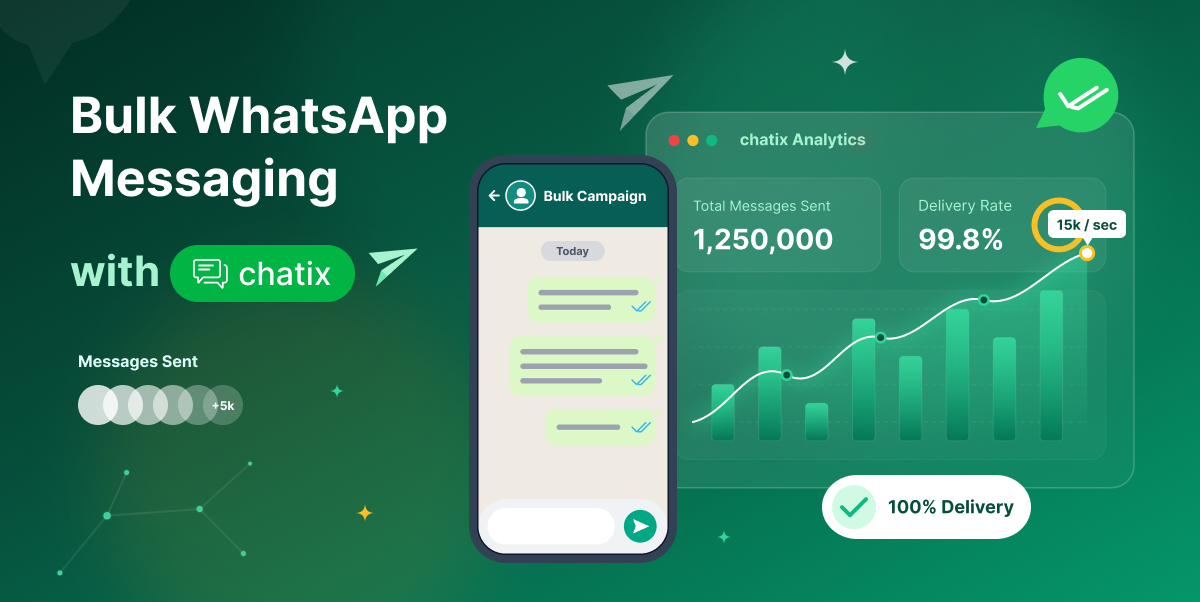
Chatix connects the WhatsApp Business API to your Shopify store and handles bulk messaging without any technical setup.
Step 1. Install Chatix from the Shopify App Store and connect your WhatsApp Business number.
Step 2. Enable the WhatsApp Business API in the dashboard. The app handles Meta verification — no separate application required.
Step 3. Build your contact list. Upload contacts via CSV or sync Shopify customer data directly. Apply filters and tags to segment by purchase history, location, or order value.
Step 4. Select or customise your message template. Pre-approved templates are available immediately. Add dynamic variables — customer name, product name, discount code.
Step 5. Schedule your broadcast. Set delivery date and time, confirm your segment, and launch. The campaign sends automatically to your full list.
Step 6. Review performance in the analytics dashboard after the campaign — delivery rate, open rate, and click rate.
For the full Shopify-specific API setup including opt-in configuration and automation, the WhatsApp Business API for Shopify guide covers it in detail.
Bulk WhatsApp Messaging Use Cases for Shopify Stores
Knowing how to send 1,000 messages is only half the picture. What you send — and to which segment — determines whether those messages drive revenue or get ignored.
1. Flash Sales and Limited-Time Offers on Shopify
Time-sensitive campaigns are where WhatsApp bulk messaging consistently outperforms email. A flash sale announcement sent to 5,000 opted-in customers reaches most of them within minutes — while the offer is still live and actionable. Email campaigns reaching peak opens six hours later often land after the sale has ended.
2. New Product Launches — Segmented by Purchase History
New product announcements sent to past buyers from the same category consistently outperform generic launches. A customer who bought from your women's clothing range is a more relevant audience for a new women's collection than your entire list. Segmentation inside Chatix makes this straightforward — select by product category, order history, or any custom tag.
3. WhatsApp Abandoned Cart Recovery Campaigns
A scheduled broadcast to customers who abandoned carts in the last 24 to 48 hours supplements your automated cart recovery flow for higher-volume recovery windows. Go through our latest blog post on How to recover Abandoned Carts on Shopify using WhatsApp.
4. Seasonal Campaigns — BFCM, Diwali, Eid, and More
Scheduling seasonal broadcasts in advance inside Chatix means they go out at the optimal time without manual intervention on the day. For Shopify stores in India, the Middle East, and Southeast Asia, festival season campaigns are the highest-volume WhatsApp sends of the year.
For help setting up the WhatsApp chat widget that builds your opted-in contact list before any bulk send, the How to Add WhatsApp Chat to Your Shopify Store guide covers the full setup.
What Gets WhatsApp Numbers Banned?
1. Why Unofficial WhatsApp Bulk Tools Get Numbers Banned?
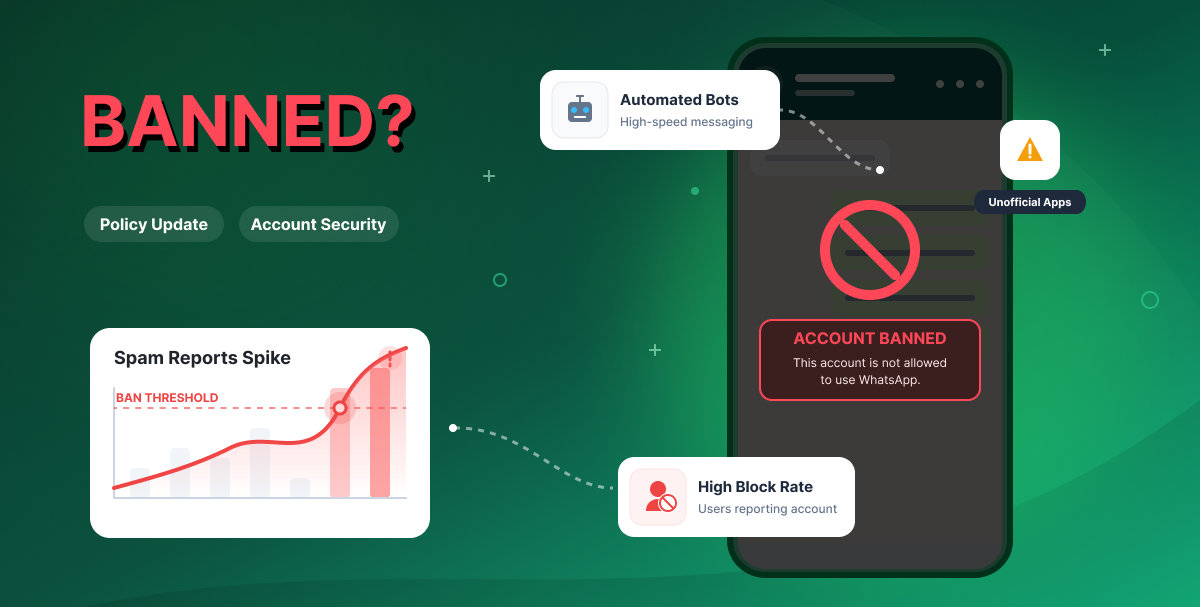
Any tool that bypasses WhatsApp's official API — browser automations, modified WhatsApp versions, unofficial bots — operates against WhatsApp's terms of service. These tools simulate human behaviour at speed, which is exactly what WhatsApp's detection system flags. Number restrictions from unofficial tools are common and often permanent. For a Shopify store that depends on WhatsApp for customer communication, a permanent ban is a serious operational risk.
2. How Unverified Contacts Trigger WhatsApp Restrictions?
When recipients block or report your number, WhatsApp's quality score for your account drops. A sufficient drop triggers sending restrictions. This is why opted-in audiences achieve better results — not just because of engagement, but because they don't generate the block signals that restrict numbers.
3. Why New API Numbers Need to Start Small?
New WhatsApp Business API numbers have messaging tier limits that increase as your account builds a quality history. Sending a large campaign from a new API number before it's properly warmed up can trigger temporary restrictions even when using the official API correctly. Start with smaller sends and increase volume gradually over the first few weeks.
4. How to Handle Opt-Outs to Protect Your WhatsApp Account?
A customer who replies 'stop' and continues to receive messages is a direct policy violation and a block signal. Proper API tools handle opt-outs automatically — which is another reason unofficial tools create disproportionate risk for Shopify merchants who depend on WhatsApp for ongoing customer communication.
The ban risks covered above are part of a broader pattern — the WhatsApp marketing mistakes Shopify merchants make guide covers the full list of what goes wrong and how to avoid each one before it affects your account.
Final Thoughts
Sending 1,000 WhatsApp messages at once is straightforward once you're using the right method. Broadcast lists and the Business App have a hard ceiling at 256 contacts. Unofficial tools bypass that ceiling but create a different and more serious risk — a permanently banned number that cuts off your entire WhatsApp customer communication channel.
The WhatsApp Business API removes the ceiling entirely and keeps your number safe — because messages go to Shopify customers who asked for them, using templates WhatsApp has already approved. That's not a constraint. That's what makes bulk messaging work sustainably at scale.
Chatix connects the WhatsApp Business API directly to your Shopify store — handling everything from contact management to template approval to campaign scheduling — so you can send your first 1,000-message campaign without any technical setup.
For merchants who want a full framework on what to send, when to send it, and how to structure campaigns across your opted-in list, the WhatsApp marketing campaigns guide for ecommerce covers campaign planning, timing, and compliance in detail.
Frequently Asked Questions
1. Can I send 1,000 WhatsApp messages at once for free?
Ans: The free broadcast list method is limited to 256 contacts per list. To reach 1,000 people you'd need four separate lists sent manually — technically possible but impractical for regular campaigns. WhatsApp API messaging has per-conversation charges set by Meta, starting from a few cents per conversation depending on your market.
2. How to Send Unlimited Messages on Whatsapp?
Ans: The fastest method is using WhatsApp Broadcast for small lists and the WhatsApp API for larger or automated campaigns.
3. Will sending bulk WhatsApp messages get my number banned?
Ans: It depends on the method. Unofficial tools that bypass WhatsApp's API commonly result in permanent bans. The official WhatsApp Business API does not risk bans when used correctly — sending to opted-in contacts using approved templates. The risk comes from the workaround, not from bulk messaging itself.
4. How many contacts can I add to a WhatsApp Broadcast list?
Ans: You can add up to 256 contacts per broadcast list on WhatsApp Business.
5. Do WhatsApp bulk message recipients need to have my number saved?
Ans: For broadcast lists using the WhatsApp Business App — yes, recipients must have your number saved or the message won't be delivered. For WhatsApp Business API messages — no. API messages reach opted-in contacts regardless of whether they've saved your number.
6. What is the difference between WhatsApp broadcast and WhatsApp API bulk messaging?
Ans: WhatsApp broadcast is limited to 256 contacts per list with no automation, scheduling, segmentation, or analytics. WhatsApp API bulk messaging has no contact limit and supports full automation, Shopify data integration, scheduling, personalisation, and campaign performance tracking.
7. How quickly can I set up WhatsApp bulk messaging for my Shopify store?
Ans: With Chatix, setup takes under an hour — install the app, connect your WhatsApp Business number, enable the API, and upload contacts. Template approval typically takes a few hours. Your first bulk campaign can be live the same day.