


WhatsApp vs SMS for Shopify: What Each Actually Costs You
WhatsApp Marketing Published: October 05, 2026
WhatsApp vs SMS for Shopify stores isn't really about which channel is "better." It's about what each channel actually costs you, not a generic blanket rate. Most comparisons stop at open-rate stats and skip the billing details entirely.
Both channels changed recently. Meta moved WhatsApp from conversation-based billing to per-message pricing in mid-2025. SMS in India still runs through DLT (Distributed Ledger Technology)-registered routes, with its own rules around message length and the national Do Not Disturb registry.
Getting this wrong is expensive either way. You either overspend on WhatsApp for messages that didn't need it, or underspend on SMS reliability for messages that had to land. That's where most Shopify messaging budgets quietly leak money.
Quick Answer
WhatsApp usually costs more per message but wins on engagement for marketing and cart-recovery sends. SMS stays cheaper and more reliable for OTPs and time-critical alerts. The real deciding factor: whether your checkout flow lands WhatsApp's free utility-template window, and whether your SMS reaches customers past India's DND registry.
Key Takeaways
- WhatsApp switched from conversation-based to per-message billing in July 2025. Many stores are still budgeting on the old model.
- SMS marketing can't legally reach numbers on India's DND list unless the message is transactional. WhatsApp has no equivalent national blocklist.
- Utility-category WhatsApp templates are free inside an open 24-hour window. On Shopify, a cash-on-delivery (COD) confirmation sent right after checkout often qualifies; a delivery update sent days later usually doesn't.
- SMS in India runs through DLT-registered routes, typically ₹0.10 to ₹0.25 per transactional message before provider markup.
- Standard SMS caps at 160 characters per segment. Going one character over splits the message into two billed segments, doubling the cost.
- SMS still wins for OTPs and any message that has to reach a basic feature phone with no WhatsApp installed.
How Does WhatsApp Compare to SMS for Shopify Stores?
WhatsApp and SMS differ most on billing model, reach, and compliance. WhatsApp costs more per message on average but supports rich media and two-way replies; SMS costs less per message and needs no app or internet connection, but stays plain text and one-way.
| Factor | WhatsApp Business Platform | SMS (India, DLT routes) |
|---|---|---|
| Billing model | Per message, since July 2025 (was conversation-based before) | Per message, always has been |
| Typical cost per message | Varies by category and country; utility/authentication can be free in-window | Roughly ₹0.10–₹0.25 for transactional (confirm against your current provider dashboard) |
| Rich content | Images, catalogs, buttons, order tracking links | Plain text only, 160 characters per segment |
| Reach | Requires WhatsApp installed and an internet connection | Works on any phone, including feature phones, no data needed |
| Two-way conversation | Yes, customers can reply and you can respond free within the open window | No, one-way broadcast only |
| Regulatory restriction | Opt-in based; no national do-not-contact registry blocks delivery | Blocked for DND-registered numbers unless the message is transactional |
| Best for | Cart recovery, order updates with images, two-way support | OTPs, urgent alerts, reaching customers with poor connectivity |
How Much Does WhatsApp Marketing Cost Your Shopify Store?
WhatsApp marketing now costs per message, not per conversation. Meta switched the entire platform to per-message pricing on July 1, 2025, and what you pay depends on which template category you're sending.
Meta's official pricing documentation confirms the shift. If your mental model still assumes "one price covers everything sent in a day," it's out of date.
What you pay depends on the template category:
- Marketing templates: charged every time they're delivered, no exceptions.
- Utility templates: covers order confirmations and shipping updates. Free if sent inside an open 24-hour customer service window; charged, at a lower rate than marketing, outside it.
- Authentication templates: used for OTPs, charged separately, with volume-based discounts as you send more per month.
That utility exception matters more than it sounds.
A Shopify store that triggers an automated "thanks for your order" message right after checkout is often still inside the window the customer opened by browsing or messaging the store. A delivery update sent three days later almost never is.
Here's an honest take: most Shopify merchants over-worry about WhatsApp's sticker price and under-worry about template misclassification.
We've seen stores get billed at marketing rates for messages that should have qualified as utility, simply because the template wording drifted toward promotional phrasing during an edit. That's a bigger cost leak than the per-message rate itself.
A Rough Monthly Example
- A store sending 5,000 order-related WhatsApp messages a month, with roughly 60% landing inside an open customer service window because the checkout flow nudges customers to message first: those 3,000 messages cost nothing under the utility exception.
- The remaining 2,000 get charged at the out-of-window utility rate, lower than marketing, but still real money.
- Send enough volume and the per-message rate drops too. Meta discounts utility and authentication messages past certain monthly thresholds.
The practical takeaway: the checkout flow itself, not just the template, decides a meaningful chunk of your WhatsApp bill.
How Much Does SMS Marketing Cost Your Shopify Store?
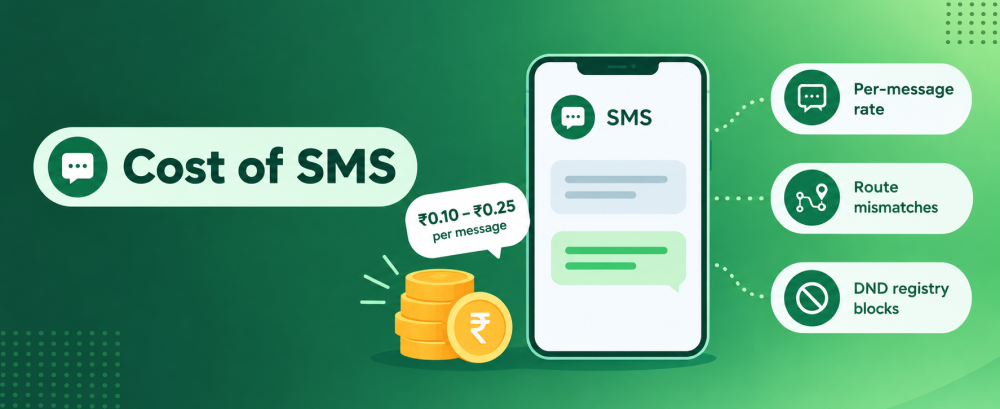
SMS marketing in India typically costs ₹0.10 to ₹0.25 per transactional message, sent through DLT-registered routes via the TRAI (Telecom Regulatory Authority of India) DLT portal. That registration isn't optional: non-compliant templates get blocked or fined outright.
Treat that per-message rate as a market estimate, not a fixed number. Confirm the exact figure on your own gateway's published pricing page before budgeting against it.
A few SMS-specific cost traps worth knowing:
- Character limits: standard SMS caps at 160 characters per segment. Go one character over and the message splits into two billed segments, a doubled bill on every send that runs long.
- Route mismatches: transactional, promotional, and OTP routes each have separate DLT registration and pricing. A flash-sale blast and a COD confirmation aren't interchangeable at the compliance level.
- The DND registry: India's national Do Not Disturb list blocks promotional SMS to registered numbers, unless the customer explicitly opted in. Transactional messages, like order confirmations, still get through.
A Rough Monthly Example
- A store sending 3,000 transactional SMS a month for order confirmations and delivery alerts, at roughly ₹0.15 per message, lands around ₹450 a month before provider markup.
- Scale that to 10,000 messages during a festive sale month and the cost climbs closer to ₹1,500.
- Unlike WhatsApp, there's no free-window exception to plan around. Every delivered SMS is a line item, which is exactly why SMS budgets are easier to forecast but harder to shrink.
For the full breakdown of how the API is set up, what BSP options cost, and how Meta's per-message pricing applies across categories, the WhatsApp Business API for Shopify guide covers the decision before you commit to a provider.
When Does WhatsApp Win for Shopify Order Updates?
WhatsApp wins for Shopify order updates when the message benefits from richness, like a product image or a real reply option, and can land inside the free utility window. Here's what that looks like on a real store:
- Picture a mid-size home decor Shopify store running COD as its main payment option, common across tier-2 Indian markets.
- Problem: a meaningful share of COD orders went unconfirmed because customers ignored plain SMS texts from unfamiliar sender IDs, leading to failed deliveries and return shipping costs.
- Action: the store switched COD confirmation to a WhatsApp utility template with an order summary and a one-tap "confirm" button, sent inside the window opened at checkout.
- Result: confirmation replies came back faster and more often, since customers could see exactly what they ordered instead of a cryptic SMS code, and because the message qualified as utility inside an open window, it cost nothing to send.
Delivery tracking links, "your order is out for delivery" updates with a map, and post-purchase support conversations fit this same pattern. For why this also cuts down 'where's my order' tickets specifically not just confirmation rates, the WhatsApp order updates guide covers the support-side impact in detail.
It's not automatic. Without an opt-in checkbox or a WhatsApp button at checkout, you're sending those templates cold, full rate, every time.
Guest-checkout-heavy stores feel this most, since the customer never messages first to open a window. Budget WhatsApp utility messages at the paid rate by default if that's your setup.
When Does SMS Still Beat WhatsApp for Shopify Stores?
SMS wins in three specific situations, and pretending otherwise is how merchants end up under-covered.
- OTPs and account verification: a customer resetting a password or verifying a phone number needs delivery that doesn't depend on having WhatsApp installed, a data connection, or the message not getting buried in an unread chat thread. SMS lands on the lock screen within seconds.
- Customers without WhatsApp or with patchy connectivity: India's smartphone penetration is high but not universal, and rural or low-bandwidth areas still see WhatsApp messages queue or fail to deliver promptly.
- Anything time-critical where a missed message has real cost: a "your payment failed, retry now" alert or a delivery-attempt-failed notice needs guaranteed reach more than it needs a product image.
The honest trade-off: SMS's near-universal delivery comes at the cost of zero two-way conversation and zero rich content. You're trading engagement for certainty.
That trade, certainty over engagement, is worth making for OTPs, low-connectivity customers, and time-critical alerts. No amount of WhatsApp's richer formatting makes up for a payment-failure alert that never arrives because the customer's phone had no signal for WhatsApp but still picked up a plain SMS.
Can You Run WhatsApp and SMS Together on Shopify?
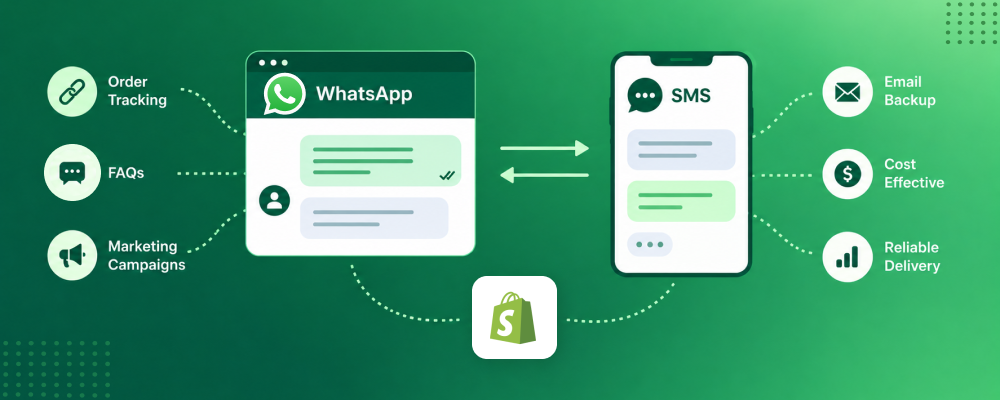
The realistic answer for most Shopify stores isn't "pick one." It's assigning each channel to the message type it's actually built for.
- Order confirmations and shipping updates with tracking links → WhatsApp, timed to land inside an open window where possible.
- OTPs and payment-failure alerts → SMS, full stop.
- Marketing campaigns → split by what you're promoting. A flash sale with product images performs better on WhatsApp, while a simple "sale ends tonight" reminder can go either way depending on your audience's channel habits.
If you're running festive or flash-sale campaigns specifically, WhatsApp Marketing Campaigns for Ecommerce walks through the calendar and timing side of that in more detail.
A practical fallback worth setting up: if a WhatsApp utility template fails to deliver (number not on WhatsApp, message undeliverable), route automatically to SMS as backup for anything genuinely time-sensitive.
This is one of the flows Chatix's automation is built to handle on Shopify specifically. It's not unique to any one app, but worth checking whether yours supports it before assuming your order-update flow has a safety net.
For a closer look at how WhatsApp stacks up against a third channel entirely, WhatsApp vs Email for Shopify Order Updates covers the same decision from the email side.
What WhatsApp and SMS Mistakes Do Shopify Stores Make?
A few mistakes show up often enough to call out specifically. Each one is a real cost leak, not a theoretical risk.
- Letting marketing language creep into utility templates: a "thanks for your order!" confirmation that adds "check out our new arrivals" can get reclassified from utility to marketing, charged at the higher rate, and risk rejection on resubmission.
- Ignoring the 160-character SMS segment limit: adding a tracking link and delivery window to one template can push it past the limit without anyone noticing, quietly doubling the per-message cost on everyWhat WhatsApp and SMS Mistakes Do Shopify Stores Make? send.
- Treating WhatsApp and SMS opt-ins as one checkbox: they're legally What WhatsApp and SMS Mistakes Do Shopify Stores Make?and operationally separate. A customer who agreed to SMS updates hasn't agreed to WhatsApp marketing.
- No fallback when a WhatsApp message fails to deliver: if a customer's number isn't on WhatsApp or the message bounces, a store with no automatic SMS fallback for critical updates just loses that notification entirely.
Why This Decision Keeps Changing
Worth saying plainly: this isn't a one-time decision. Meta updates WhatsApp pricing up to four times a year, and SMS provider rates shift with volume commitments and DLT policy updates. A cost comparison accurate in January can be stale by July. Re-check both before locking in a messaging budget for the year.
For the broader set of WhatsApp mistakes that cost Shopify stores money - beyond the billing and opt-in errors above - the WhatsApp marketing mistakes guide covers the full list including compliance mistakes that get numbers restricted.
Final Thoughts
Neither channel is the universal answer, and any post telling you otherwise is selling something. WhatsApp's move to per-message pricing changed the math for Shopify stores that lean on it heavily, while SMS's DLT and DND rules in India mean compliance, not just cost, decides what you can actually send.
Match the channel to the message: order updates and cart recovery go to WhatsApp where you can land inside a free window, OTPs and urgent alerts go to SMS. The cost question mostly solves itself from there. If you're setting this up on Shopify, Chatix handles the WhatsApp side of that automation directly from your store.
Frequently Asked Questions
Is WhatsApp cheaper than SMS for Shopify stores?
It depends on the message, not the channel. A WhatsApp order update can cost nothing if it lands inside the free utility window that opens once a customer messages the store, while a WhatsApp marketing blast usually costs more per message than a standard SMS in India.
Can WhatsApp replace SMS for OTPs and verification codes?
Not fully. WhatsApp requires the app installed and an internet connection, so a share of customers won't receive it reliably. Some stores see higher WhatsApp OTP completion rates, but the safest setup tries WhatsApp first and falls back to SMS automatically if delivery fails.
Do I need separate consent for WhatsApp and SMS?
Yes. Opt-in for WhatsApp marketing messages and opt-in for SMS marketing are tracked and enforced separately, under different rules. A customer agreeing to one doesn't automatically cover the other, so keep two distinct checkboxes at checkout rather than one combined opt-in.
Which channel works better for abandoned cart recovery?
WhatsApp generally performs better here because it supports product images and a direct reply option, giving the customer more reason to act than a plain text SMS link. SMS can still work as a short, urgent nudge for carts with a tight discount window, but it rarely matches WhatsApp's reply-and-recover pattern.
Does WhatsApp work without an internet connection?
No. WhatsApp needs a data or Wi-Fi connection to send and receive, so a customer with no connectivity won't get the message until they're back online. SMS runs over the cellular network instead and works on any phone, including basic feature phones with no internet access at all.
Should Shopify stores use WhatsApp and SMS together?
Most stores get better results running both, assigned by message type: WhatsApp for rich, two-way updates and SMS for OTPs and guaranteed-delivery alerts. Treating it as an either-or choice usually means losing either the engagement WhatsApp drives or the guaranteed reach SMS provides.
Is SMS being replaced by WhatsApp for e-commerce notifications?
Not entirely, and probably not soon. WhatsApp has taken over a large share of marketing and order-update messaging, but SMS keeps its role for OTPs and feature-phone reach, so most Shopify stores run both rather than retiring one in favor of the other.