



How to Schedule Messages on WhatsApp to Save Time?
How-to Guides Published: May 26, 2025
Scheduling a WhatsApp message sounds simple. And for a birthday reminder or a one-off personal note — it is. But if you're running a Shopify store and you're counting on scheduled messages to recover abandoned carts, confirm orders, or send broadcast campaigns to hundreds of customers — simple tools will let you down faster than you expect.
This guide covers both sides honestly. How to schedule WhatsApp messages on Android, iPhone, and WhatsApp Business — and then, more importantly, why Shopify merchants and business owners need a completely different approach to make scheduling actually work at scale.
Quick Answer
Yes, you can schedule WhatsApp messages — but the method depends entirely on what you're trying to achieve. Personal users can use third-party apps on Android or Shortcuts on iPhone for simple scheduling. Businesses running on Shopify need WhatsApp Business API tools that tie scheduling to real store events like abandoned carts, order confirmations, and broadcast campaigns.
Key Takeaways
- Personal scheduling apps work for one-off messages but cannot handle business automation or broadcasts
- Third-party scheduling apps that use Android accessibility features can violate WhatsApp's terms of service and risk number bans
- WhatsApp Business App has limited built-in scheduling — away messages and greeting messages only
- Shopify merchants need API-level scheduling tied to store triggers, not manual timed sends
- Sending bulk scheduled messages without proper opt-in compliance can get your WhatsApp number restricted
Can You Actually Schedule WhatsApp Messages? Here's the Honest Answer
WhatsApp does not have a native built-in message scheduler for regular users. There is no 'schedule send' button the way Gmail or Apple Messages has one. So yes, it's possible — but it always involves a workaround of some kind, and not all workarounds are equal.
For personal use, third-party apps fill the gap reasonably well. For businesses, the WhatsApp Business App adds greeting and away messages. For serious business use at scale — especially if you're running a Shopify store — the WhatsApp Business API is the only reliable, compliant, and scalable path.
The method that's right for you depends entirely on what you're scheduling, for whom, and how often. The rest of this guide breaks that down clearly.
How to Schedule WhatsApp Messages on Android?
The most widely used Android app for scheduling WhatsApp messages is SKEDit. Here's how it works:
- Download SKEDit from the Google Play Store and open it.
- Select WhatsApp as the app you want to schedule messages for.
- Grant the accessibility permission SKEDit requests — this is how it sends messages automatically.
- Choose the contact or group you want to message.
- Type your message, set the date and time, and confirm the schedule.
- Keep your phone unlocked and connected at the scheduled time for the message to send.
It works for simple, occasional scheduling — a reminder, a follow-up, a planned message to one person.
Important compliance note- SKEDit and similar apps use Android accessibility services to simulate taps on your screen. WhatsApp's terms of service prohibit automated or bulk messaging through unofficial means. Using these apps for personal, low-frequency messages is generally fine in practice — but using them to send bulk messages or business communications at scale puts your number at risk of being flagged or banned.
How to Schedule WhatsApp Messages on iPhone?
iPhone doesn't have a direct equivalent to SKEDit. The most common workaround is using the Apple Shortcuts app combined with an automation trigger.
- Open the Shortcuts app on your iPhone (pre-installed on iOS 13 and above).
- Tap Automation at the bottom of the screen, then tap the + button to create a new automation.
- Choose 'Time of Day' as your trigger and set the exact time you want the message to send.
- Tap 'Add Action' and search for 'Send Message via WhatsApp.
- Set the recipient and type the message content.
- Turn off 'Ask Before Running' so the automation fires without manual confirmation.
This works for recurring scheduled messages on iPhone — daily check-ins, weekly reminders, and similar use cases.
Important compliance note- The same limitation applies here as on Android. This method works for personal, low-frequency sends. It is not suitable for business messaging, customer communications, or anything that resembles bulk or automated outreach. WhatsApp monitors for unusual sending patterns regardless of the method used.
WhatsApp Business App — What the Built-In Scheduling Feature Actually Does?
The WhatsApp Business App has two built-in messaging features that many people mistake for full scheduling — but they're more limited than they appear.
Away Messages — You can set an automatic reply that sends when a customer messages you outside your business hours. You define the hours, write the message, and it fires automatically. This is useful for setting expectations but it's reactive, not proactive — it only sends when someone messages you first.
Greeting Messages — A welcome message that sends automatically the first time a customer contacts your business number. Again, reactive — triggered by the customer, not by you.
What the WhatsApp Business App cannot do:
- Schedule a message to send at a specific future time
- Send a message proactively to multiple customers simultaneously
- Trigger messages based on customer behaviour like an abandoned cart or a placed order
- Send broadcast campaigns to more than 256 contacts at once
For a small business handling a handful of customer queries manually, the Business App is a reasonable starting point. For a Shopify store with consistent order volume and customers expecting timely, relevant messages — it runs out of capability quickly.
Why Personal Scheduling Tools Break Down When You're Running a Store?
Here's where most guides stop — they give you the steps and leave you to figure out the rest. But if you're running a Shopify store, the gap between what personal scheduling tools offer and what your business actually needs is significant.
Personal scheduling tools require you to manually write and schedule every message. That's manageable for ten customers. It becomes unworkable at a hundred. And it completely falls apart during a sale, a product launch, or a high-traffic period like BFCM when you need to communicate with hundreds of customers simultaneously.
More importantly, personal scheduling tools have no connection to what's actually happening in your store. They can't know that a customer just abandoned a checkout. They can't trigger an order confirmation the moment a purchase is placed. They can't pause a scheduled promotional message when a product goes out of stock.
That's not a scheduling problem — it's an automation problem. This is where WhatsApp automation for Shopify becomes the right solution — messages go out based on what customers actually do in your store, not what you manually schedule in advance.
Automation is what separates a business that uses WhatsApp effectively from one that just uses it occasionally. The solution isn't a smarter scheduling app. It's connecting WhatsApp directly to your Shopify store so messages go out based on what your customers actually do — not what you manually set up in advance.
How Shopify Merchants Handle WhatsApp Scheduling Properly?
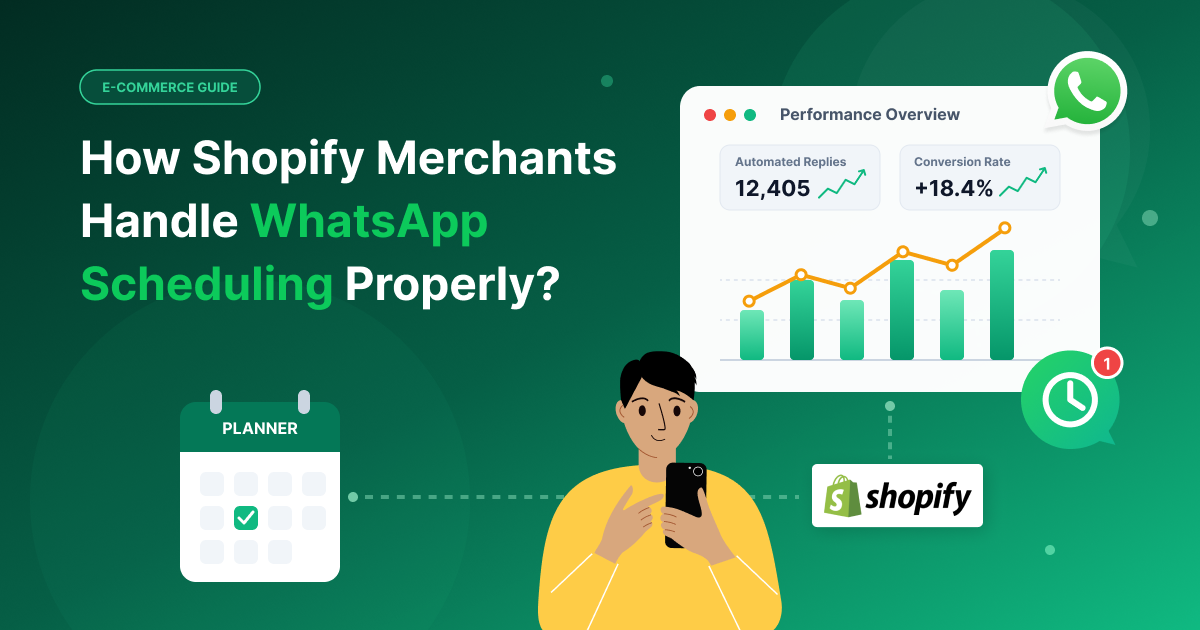
For Shopify stores, proper WhatsApp scheduling works through the WhatsApp Business API — not third-party apps, not manual timed sends. The API connects WhatsApp directly to your store and lets you trigger messages based on real customer actions.
Here's what that looks like in practice:
- Abandoned cart recovery- A customer adds products to their cart and leaves without buying. A scheduled message goes out automatically 30 to 60 minutes later with a personalised reminder. No manual input needed. Understanding the difference between cart abandonment and checkout abandonment helps you set the right trigger timing for your recovery messages.
- Order confirmation- The moment an order is placed, a WhatsApp confirmation message fires automatically with the order details. Faster and more personal than email.
- COD verification- For cash on delivery orders, a confirmation message goes out automatically asking the customer to confirm before the order is dispatched. Reduces failed deliveries significantly.
- Broadcast campaigns- Promotional messages, restock alerts, and sale announcements can be scheduled to go out to your opted-in customer list at a specific date and time — planned in advance, sent automatically.
Tools like Chatix handle all of this natively inside Shopify — no separate configuration, no developer needed. The WhatsApp Business API is built in, the Shopify triggers are pre-connected, and scheduling works based on what happens in your store rather than what you remember to set up manually.
You can also read How to Send Broadcast Messages on WhatsApp for a complete guide on planning and sending scheduled broadcast campaigns to your customer list.
The Mistakes That Get WhatsApp Numbers Flagged or Restricted
This section matters more than most guides acknowledge. WhatsApp actively monitors for policy violations and the consequences — a restricted or permanently banned number — can seriously disrupt a business that relies on it for customer communication.
1. Using third-party apps for bulk messaging. Apps like SKEDit are designed for personal, low-frequency use. Using them to send the same message to dozens or hundreds of contacts at once is exactly the kind of behaviour WhatsApp flags as spam.
2. Messaging contacts who haven't opted in. WhatsApp's Business API policy requires that customers opt in before receiving business-initiated messages. Sending promotional or automated messages to contacts who haven't agreed to receive them is a policy violation — not just bad practice.
The WhatsApp Shopify integration setup guide covers how to collect proper opt-ins during checkout — the right way to build your messaging list from day one.
3. Sending too many messages too quickly. Even legitimate businesses can trigger restrictions by sending a high volume of messages in a short period, especially from a new number. Warm up your number gradually and stay within reasonable send limits.
4. Using unofficial API access. Some tools claim to offer WhatsApp automation without using the official API. These workarounds are against WhatsApp's terms and carry the highest risk of permanent number bans.
5. Ignoring customer opt-outs. If a customer replies stop or blocks your number, continuing to message them is both a policy violation and a trust issue. Proper tools handle opt-outs automatically — manual processes often miss them.
The WhatsApp API Features for Shopify Merchants guide covers compliance in more detail — what the API allows, what it doesn't, and how to stay on the right side of WhatsApp's policies.
Conclusion
Scheduling WhatsApp messages is straightforward for personal use — Android and iPhone both have workable solutions for occasional sends. But for Shopify store owners, the real question isn't how to schedule a message. It's how to make WhatsApp work automatically around what your customers actually do in your store.
Personal tools can't do that. The WhatsApp Business API can — and if you're running a Shopify store and want scheduling, automation, and broadcasts all working together without manual input, Chatix is built specifically for that.
Frequently Asked Questions
1. Can I schedule WhatsApp messages without a third-party app?
Ans: On Android and iPhone, there is no native WhatsApp scheduling feature for regular users. The WhatsApp Business App offers away messages and greeting messages but these are reactive, not scheduled sends. For true proactive scheduling, a third-party app or the WhatsApp Business API is required.
2. Is it safe to use SKEDit or similar apps to schedule WhatsApp messages?
Ans: For occasional personal use — a birthday message, a single reminder — the risk is low. For business use or bulk messaging, these apps violate WhatsApp's terms of service and can result in your number being flagged or restricted. Businesses should use the official WhatsApp Business API instead.
3. Can WhatsApp Business schedule messages to multiple customers at once?
Ans: The WhatsApp Business App cannot schedule proactive messages to multiple customers simultaneously. Broadcast lists are limited to 256 contacts and messages must be sent manually. For scheduled broadcasts at scale, the WhatsApp Business API is required.
4. How do Shopify stores send scheduled WhatsApp messages automatically?
Ans: Shopify stores use the WhatsApp Business API connected to their store through tools like Chatix. Messages are triggered automatically based on store events — abandoned carts, order placements, COD verifications — without any manual scheduling required.
5. What happens if my WhatsApp number gets flagged for automated messaging?
Ans: WhatsApp may restrict your number temporarily, limit your messaging volume, or permanently ban it depending on the severity of the violation. Recovery from a permanent ban is not always possible and can take significant time — which is why using compliant, API-based tools for business messaging is strongly recommended over workarounds.