


What Is Chat Marketing? How Shopify Stores Use It to Sell More
WhatsApp Marketing Published: April 15, 2025
Most Shopify merchants spend months optimising ads and email flows — and then lose the sale in the last 30 seconds because no one was there to answer a question. That gap costs real money: 42% of customers would stop using a brand that does not offer real-time support, and the moment before checkout is where the most fixable revenue losses happen.
Chat marketing closes that gap. It puts a conversation exactly where and when the customer needs it — on your product page when they are comparing options, in their WhatsApp inbox when they abandoned a cart, and in their hands after delivery to collect a review.
This post covers what chat marketing actually is, five benefits backed by ecommerce benchmarks, six tactics Shopify merchants can implement without a developer, and how to measure whether it is working.
Quick Answer
Chat marketing for ecommerce is using messaging channels — WhatsApp, on-site live chat, and chatbots — to guide customers through the buying journey in real time. For Shopify stores, the three channels with the most measurable impact are WhatsApp (95–98% open rate, strongest in India and the Middle East), on-site live chat (88% customer satisfaction, visitors 2.8x more likely to buy), and smart chatbots (24/7 coverage at zero agent cost). Together they cover every stage of the customer journey from first visit to repeat purchase.
Key Takeaways
- Visitors who engage with live chat are 2.8x more likely to buy — ecommerce sees 4.5% chat-assisted conversion rates, the highest of any industry.
- Chat-to-conversion rates average 10–20%, compared to 2–3% for standard website forms.
- 42% of customers would stop using a brand without real-time support — chat marketing is no longer optional for Shopify stores.
- WhatsApp has a 95–98% open rate vs email's 20% — making it the highest-reach chat channel for Shopify merchants in India, the Middle East, and Southeast Asia.
- 60% of abandoned carts are recoverable with timely chat intervention — the highest-ROI individual tactic available to Shopify stores.
What Is Chat Marketing?
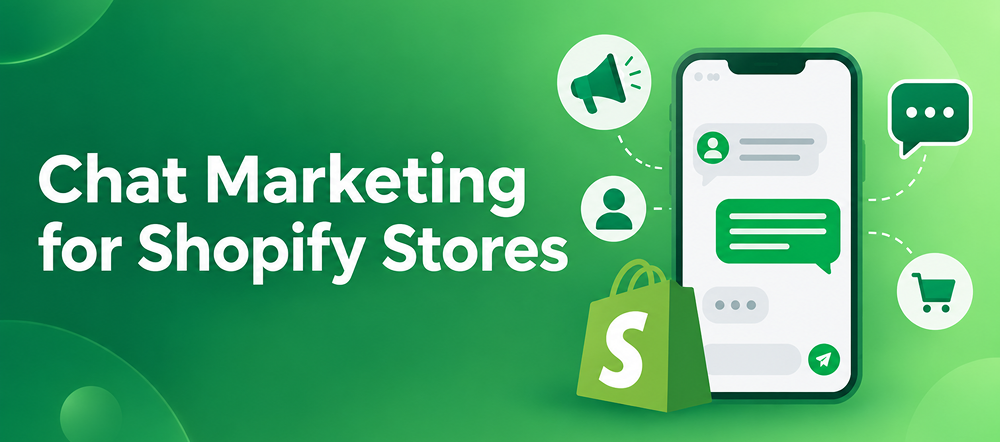
Chat marketing is not a single tool — it is a strategy. The core idea is using messaging channels to communicate with customers in real time, both proactively (triggered by store behaviour) and reactively (customer-initiated). Unlike ads that broadcast at people or emails that sit in an inbox, chat marketing creates a two-way conversation at the exact moment the customer has a question or needs a nudge.
For Shopify merchants, it spans WhatsApp outbound campaigns, on-site live chat widgets, chatbot flows, and post-purchase messaging sequences. Every channel solves a different problem in the buying journey — and together they cover the gaps that ads, email, and SEO cannot fill.
For a full WhatsApp marketing strategy built specifically for Shopify merchants, see the WhatsApp marketing guide.
5 Benefits of Chat Marketing for Ecommerce Stores
Every benefit below is backed by ecommerce-specific data. Not general marketing claims — numbers from Shopify merchant categories specifically, sourced from Freshchat, Tidio, Ringly, and GreetNow's 2026 benchmark roundups.
1. Higher Conversion Rates at Every Stage of the Journey
Visitors who engage with live chat are 2.8x more likely to complete a purchase. Chat-to-conversion rates in ecommerce average 10–20%, compared to just 2–3% for standard website forms. Ecommerce leads all industries with a 4.5% chat-assisted conversion rate.
The mechanism is simple: proactive chat on a product page — triggered when someone lingers for more than 30 seconds — intercepts the moment of doubt. A quick answer about sizing, shipping, or returns is often the only thing standing between a browser and a buyer. Chat delivers $8 ROI for every $1 invested, making it one of the highest-return channels in the ecommerce stack.
2. Instant Support That Reduces Returns and Refunds
Live chat earns an 88% average customer satisfaction rating — the highest of any digital support channel, ahead of email (61%), social media (48%), and phone (44%). The average first response time in 2026 is 46 seconds.
When a customer gets the right answer before buying, they buy the right product. That directly reduces returns. A chatbot handles basic queries 24/7 so no question goes unanswered outside business hours — and 38% of customers report that chat helped them complete a purchase they would otherwise have abandoned.
3. Personalised Recommendations Without Scaling a Sales Team
AI-powered chat tracks browsing behaviour and purchase history to recommend products based on what the customer actually viewed or bought — not generic bestsellers. For Shopify stores with large catalogues, this is the scalable alternative to a sales team.
49% of businesses see a sustained increase in conversions after two years of using chat — the returns compound as chatbot flows improve and personalisation becomes more accurate. One agent can simultaneously handle 3–5 conversations, and chatbots handle the first tier entirely.
4. Abandoned Cart Recovery in Real Time
60% of abandoned carts are recoverable with timely chat intervention. A WhatsApp message sent 30–60 minutes after abandonment consistently outperforms email for opted-in customers — especially in India and other high-WhatsApp markets where email recovery rates are below 3%.
For Shopify stores with WhatsApp opt-in at checkout, abandoned cart recovery is the single highest-ROI automation available. The full three-message sequence — timing, templates, and triggers — is covered in detail in the WhatsApp abandoned cart recovery guide.
5. Lower Support Cost Per Customer Over Time
One live chat agent handles 3–5 simultaneous conversations. Cost per chat contact runs $3–4 versus $12–20 for phone support. Chatbots handle the first tier of queries entirely, escalating only complex issues to human agents.
85% of customers expect a live chat widget on ecommerce sites. Brands that offer it see 60–63% higher repeat visit rates. The cost drops while loyalty builds — which is the economics of every Shopify merchant's ideal customer service stack.
6 Chat Marketing Tactics for Shopify Stores
These are specific tactics with a trigger, a channel, and a measurable outcome — not general recommendations to "use chat more." Each one can be set up without developer help.
Tactic 1: Proactive Chat Trigger on Product and Cart Pages
Set a chat widget to trigger automatically when a visitor spends more than 30 seconds on a product page or adds something to their cart without checking out. Message: "Need help choosing the right option?" or "Questions about delivery times?"
This intercepts the moment of hesitation. Proactive engagement features like these drove 50% of all conversation-driven purchases during BFCM 2025, according to OscarChat's conversational commerce data.
Tactic 2: WhatsApp Opt-In at Checkout
Add a WhatsApp consent checkbox at the Shopify checkout page — "Get order updates on WhatsApp." Target a 15–25% opt-in rate in the first 30 days. Every opt-in is a contact you can message for future campaigns, cart recovery, and review collection without any paid acquisition cost.
Tactic 3: Automated Abandoned Cart Message via WhatsApp
Trigger: checkout started but not completed. Message 1 at 30–60 minutes — a short, friendly reminder with no discount. Message 2 at 24 hours — soft urgency or a small discount for price-sensitive segments. Recovery rate benchmark: 15–25% for opted-in contacts.
Tactic 4: Post-Purchase Review Request via Chat
Trigger: order delivery confirmed. Channel: WhatsApp. Timing: Day 7 after delivery — early enough that the experience is fresh, late enough that the product has been used. WhatsApp review requests achieve 25–40% response rates compared to 5–10% for email. Keep the message to one sentence and one link.
Tactic 5: COD Confirmation to Reduce RTO
Trigger: cash-on-delivery order placed. Message: "Hi [name], please confirm your order — tap Yes to confirm." Simple Yes/No quick reply button. This single automation reduces return-to-origin rates by 20–30% for Shopify merchants in India where COD is high-volume and RTO is a major cost driver.
For the complete message flow, timing, and Shopify setup that makes COD verification automatic — including no-response handling — the WhatsApp COD verification guide covers the full implementation.
Tactic 6: Restock Alert via WhatsApp
Trigger: product inventory updated from zero to any positive number. Message: immediate notification to customers who previously viewed the product. CTR benchmark: 20–35%, the highest of any chat marketing message type — because these customers already expressed buying intent when the product was out of stock.
Browse the full library of ready-to-use templates for all six tactics in the WhatsApp marketing message examples post.
Which Chat Channel Works Best for Your Shopify Store?
Most Shopify merchants need two channels running simultaneously — WhatsApp for outbound marketing and cart recovery, and on-site live chat for pre-purchase questions. Chatbots layer on top of both for 24/7 first-tier coverage.
| Channel | Best for | Open/Satisfaction rate | Reach | Cost |
|---|---|---|---|---|
| Outbound campaigns, cart recovery, India and Middle East markets | 95–98% open rate | 3.3B users globally | Paid via API | |
| On-site live chat | Pre-purchase questions, product guidance | 88% satisfaction rate | Site visitors only | Low — widget based |
| Smart chatbot | 24/7 query handling, lead capture, first-tier support | Varies by channel | All channels | Medium — setup cost |
WhatsApp — Best for Mobile-First Shopify Markets

India has 535 million WhatsApp users. Messages open in under 3 minutes on average. For Shopify merchants with customers in India, the Middle East, and Southeast Asia, WhatsApp is the primary chat marketing channel — not a secondary one.
Facebook Messenger and Instagram DMs exist as channels but have meaningfully lower market penetration in these regions and are not connected to Shopify order workflows the way WhatsApp is. Chatix connects WhatsApp directly to your Shopify store and manages broadcasts, automations, and conversations from one dashboard, without needing to manage separate platforms for each channel.
To connect WhatsApp to your Shopify store and set up the foundational automations, see the Shopify WhatsApp integration setup guide.
On-Site Live Chat — Best for Pre-Purchase Guidance

79% of customers now expect live chat on ecommerce websites. A chat widget on your product or cart page intercepts customers who have a question before buying — a question that, unanswered, sends them to a competitor's site to find the answer.
The Chatix chat widget includes WhatsApp, live chat, order tracking, and FAQs in a single floating button — no separate tool or developer required. It handles multiple conversation types from one interface.
Smart Chatbots — Best for 24/7 First-Tier Coverage

Chatbots handle FAQ responses, order status checks, and basic product recommendations automatically. The AI chatbot market is growing from $9.57 billion in 2025 to $11.8 billion in 2026 — largely because the economics are compelling. Cost per automated chat contact runs $3–4 versus $12–20 for phone support, and one chatbot handles unlimited simultaneous conversations.
The hybrid model that is winning in 2026: AI handles volume and speed, human agents handle complexity and escalations. 62% of ecommerce brands plan to grow their customer experience teams in 2026, not cut them — but the roles are shifting toward managing AI rather than answering repetitive tickets.
Chat Marketing Metrics Shopify Merchants Should Track
Four numbers. Track them monthly to start — weekly once campaigns are active. These are the signals that tell you whether your chat marketing is working or needs adjustment.
| Metric | Healthy Benchmark | What it means if low |
|---|---|---|
| Chat-to-checkout rate | 10–20% | Conversations happening but not converting — review conversation scripts and chatbot flows |
| Proactive chat engagement rate | 2–5% of widget impressions | Trigger message not compelling or timing is wrong — test different trigger delays |
| First response time | Under 60 seconds | Customers leaving before agent responds — add chatbot for instant first reply |
| WhatsApp read rate | 70–85% | List quality or message relevance issue — audit recent messages for timing and segmentation |
Final Thoughts
Chat marketing works because it shows up at the right moment — not in an inbox the customer checks tomorrow, but right now, before they click away. Shopify stores in India and Southeast Asia that use WhatsApp as their primary channel are pulling ahead every quarter. The gap between those stores and the ones still relying on email is growing fast.
You don't need a big team or a complex setup to start. One chat widget and two automated flows cover most of the value from day one. Chatix connects WhatsApp and on-site live chat to your Shopify store in one place.
Frequently Asked Questions
What is chat marketing and how is it different from email marketing
Chat marketing uses real-time channels — WhatsApp, live chat, chatbots — to reach customers in the moment. Email is scheduled and one-way; chat is immediate and two-way, which is why it converts 3–5x better in ecommerce.
Is chat marketing the same as live chat
No. Live chat is one part of chat marketing. The full strategy also includes WhatsApp broadcasts, chatbot flows, and post-purchase messaging sequences.
What are the most effective chat marketing tactics for Shopify stores
WhatsApp abandoned cart recovery (15–25% recovery rate), restock alerts (20–35% CTR), and proactive product page triggers. All three run automatically once set up.
How does WhatsApp compare to live chat for ecommerce
Different jobs. WhatsApp reaches customers outside your store — cart recovery, broadcasts, post-purchase follow-ups. Live chat handles questions from customers already on your site. Most Shopify merchants need both.
Does adding a chat widget to a Shopify store improve conversion rates
Yes — visitors who engage with chat are 2.8x more likely to buy, and businesses that add live chat see an average 20% conversion rate increase.
What is a good chat-to-conversion rate for an ecommerce store
10–20% is the benchmark. Below 10% is usually a script or timing issue — not a channel problem.