


WhatsApp Interactive Messages — The Complete Guide for Shopify Stores
WhatsApp Business & API Published: August 28, 2024
WhatsApp interactive messages are usually explained as one flat list — buttons, lists, product cards, maybe a CTA or two. That explanation misses the distinction that actually matters: whether the message is free to send within an existing conversation, or whether it needs Meta's approval before it reaches anyone. For Shopify merchants, getting this wrong means either paying for something that should be free, or building a message that gets rejected before it sends.
This guide covers WhatsApp interactive messages the way they are actually categorized — session messages and templates — along with two additions Meta introduced that most guides still have not covered: WhatsApp Flows and Carousels. Each type is explained with what it does, its limits, and where it fits for a Shopify store.
By the end, you will know which type to use for a product question, an order update, or a multi-step form — and how to set each one up without developer help.
Quick Answers
WhatsApp interactive messages fall into two categories. Session messages — reply buttons, lists, product cards, Flows, Carousels — are free to send within an open conversation and need no approval. Templates — CTA and Quick Reply templates — must be pre-approved by Meta and are used to start or re-open conversations. Reply buttons are capped at 3, with 20 characters each (verify against current Meta documentation before publishing). List messages and Carousels support up to 10 items; multi-product messages support up to 30. Flows and Carousels were added in 2025–2026 and are not covered in most existing guides.
Key Takeaways
- Session messages (buttons, lists, product cards, Flows, Carousels) are free and need no approval — templates (CTA, Quick Reply) require Meta approval before they can be sent
- Reply buttons are capped at 3 per message, with a character limit per button that varies by source — verify current Meta documentation before publishing (commonly cited as 20, not 25)
- WhatsApp Flows let customers complete multi-step forms — address changes, return requests — without leaving the chat
- Carousels, added in 2025, show up to 10 scrollable cards in a single session message and do not require a product catalog
- Multi-product messages (up to 30 items) and single-product messages both pull from your Meta product catalog — they are not the same as Carousels
- For Shopify stores, interactive messages reduce back-and-forth on order questions, sizing, and delivery — each tap replaces a typed question
What Are WhatsApp Interactive Messages
A WhatsApp interactive message is any message that includes something a customer can tap instead of type — a button, a list, a product card, or a short form. Instead of replying yes or typing out an address, the customer taps an option and the conversation moves forward.
For a Shopify store, this shows up in places like: a customer asking about a product gets three reply buttons — Size Guide, Shipping Info, Talk to Us — instead of a wall of text; an order update includes a Track Order button; a returning customer sees a small carousel of products related to what they bought.
Session Messages vs Interactive Templates
WhatsApp interactive messages fall into two categories, and the difference determines both cost and setup.
Session messages are sent within an open conversation — any time in the 24 hours since the customer last messaged you. They are free, need no approval from Meta, and include reply buttons, list messages, single and multi-product messages, Flows, and Carousels.
Interactive templates are used to start a conversation or re-open one after the 24-hour window closes. They must be submitted to Meta for approval before they can be sent — this includes CTA button templates and Quick Reply templates. Approval typically takes a few hours to a day, and once approved, the template can be reused indefinitely.
The practical implication for Shopify merchants: if a customer messages you first, you can reply with any session message type immediately. If you are the one starting the conversation — an abandoned cart reminder, an order confirmation — that has to be a pre-approved template.
Types of WhatsApp Interactive Messages
Reply Buttons and List Messages
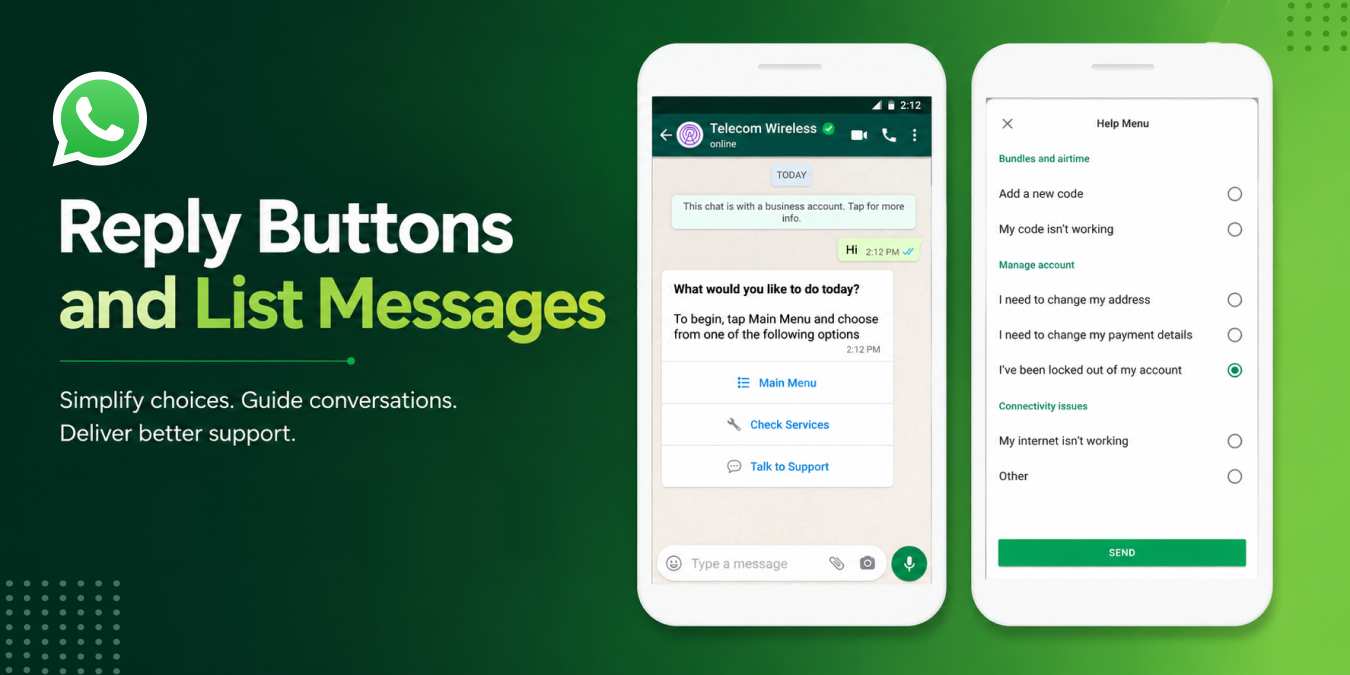
Reply buttons and list messages — sometimes called WhatsApp interactive buttons or WhatsApp business interactive buttons — are the two most common interactive types, and the most confused with each other.
Reply buttons show up to 3 buttons directly under a message. Each button holds a limited number of characters — commonly cited as 20, though this should be verified against Meta's current documentation — enough for short labels like Track Order, Size Guide, or Talk to Sales, but not a full sentence. When a customer taps one, their reply sends automatically with that exact text. In casual use, these are sometimes called quick reply buttons — though Meta's own terminology reserves Quick Reply specifically for the template version covered later in this guide.
List messages show up to 10 options in a scrollable menu, grouped into sections if needed. Where reply buttons work for a quick either-or choice, list messages work when there are more than 3 options — a list of product categories, delivery slots, or FAQ topics.
The decision is straightforward: 3 or fewer similar options means reply buttons. More than 3, or options that benefit from grouping, means a list message. For a complete WhatsApp app setup on your store that supports both formats, the how to add WhatsApp live chat button to Shopify store guide covers the foundational setup.
Single and Multi-Product Messages
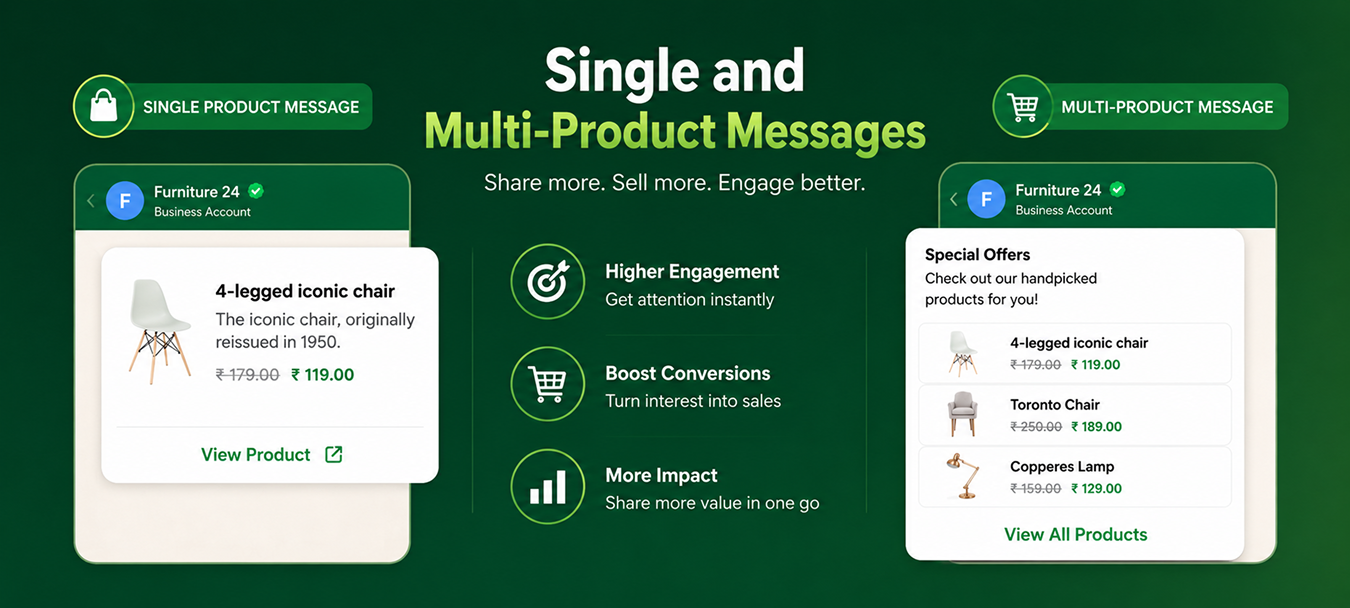
Single-product and multi-product messages both pull directly from your store's product catalog, connected through Meta Commerce Manager.
A single-product message shows one product — image, name, price, and a link — inside the chat. It is the right format when a customer asks about a specific item, or when following up on something they viewed.
A multi-product message shows up to 30 items in a scrollable card format, grouped under a header you set, like Bestsellers or New Arrivals. This is sometimes called a catalog message — it is not a separate type, it is the multi-item version of the same product message.
Both require your Shopify product catalog to be connected to Meta Commerce Manager before they will work. For a step-by-step walkthrough of setting up your product catalog and selling through WhatsApp conversations, the how to sell products on WhatsApp guide covers the full setup for Shopify stores.
WhatsApp Flows for Shopify
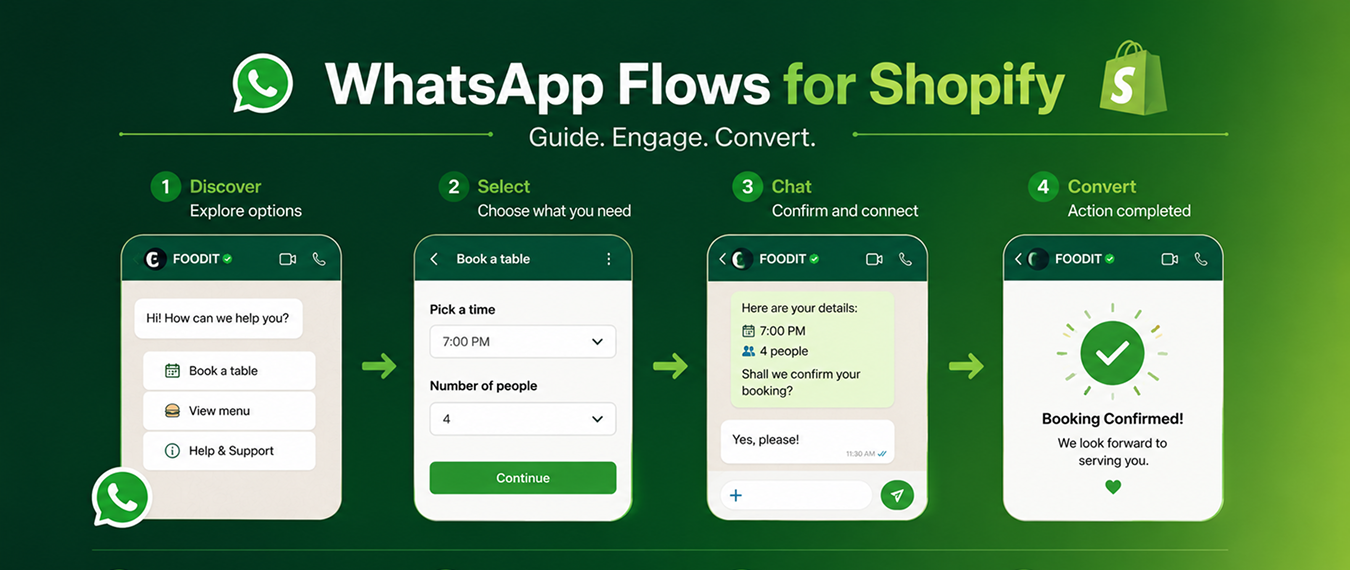
WhatsApp Flows let a customer complete a multi-step form inside the chat, without switching to a browser or app.
For most guides, the example is a booking form. For a Shopify store, the more useful examples are: a customer correcting a delivery address after placing an order, a return or exchange request that collects the order number, reason, and preferred outcome in one guided sequence, or a quick product-fit quiz that recommends a size before checkout.
Each step in a Flow can include text fields, dropdowns, checkboxes, or date pickers. The customer fills it out inside WhatsApp, taps submit, and the data comes back structured — no manual typing to interpret on either side.
Note: WhatsApp Flows, this feature, is different from the automation flows covered in the WhatsApp automation for Shopify guide — that post covers marketing sequences like cart recovery and win-back messages. Flows here refers specifically to Meta's interactive form feature.
Flows are a session message — free to send within an open conversation. No approval is required for the Flow itself, though the message that triggers it may be a template if you are starting the conversation.
WhatsApp Carousels
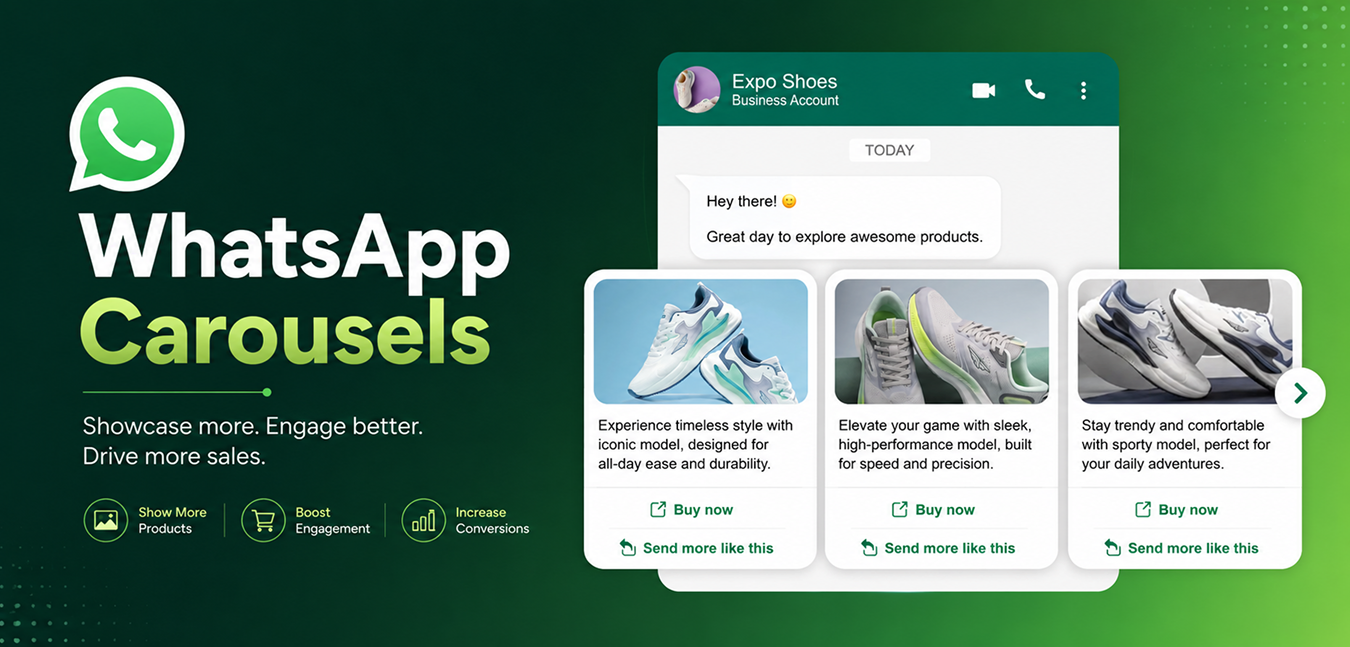
Carousels are one of the newer additions to WhatsApp's interactive message types — multiple scrollable cards in a single message, each with its own image, text, and button.
Unlike multi-product messages, Carousels do not require a product catalog connection. Each card is built individually within the message itself, which makes Carousels useful for things that are not in your product catalog — for a Shopify store, this could be a size-guide breakdown by category, a comparison of shipping options, or a set of style pairings for a new collection launch.
Carousels support up to 10 cards per message. As a session message, they are free to send within an open conversation.
CTA and Quick Reply Templates
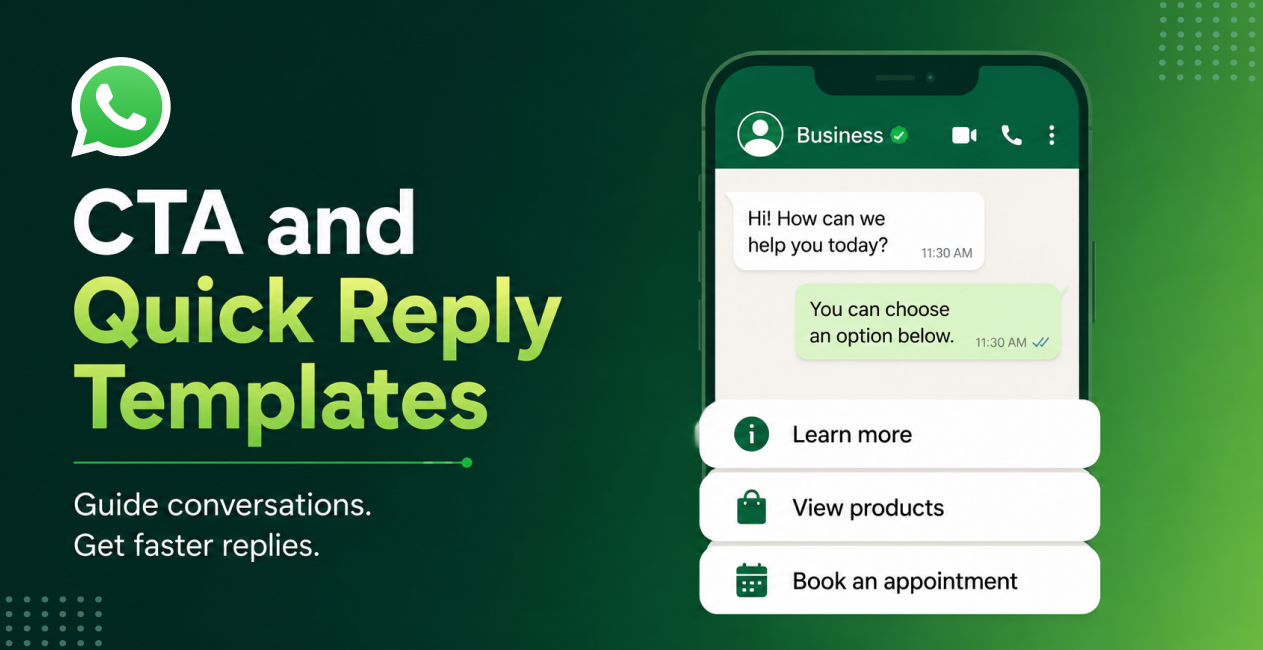
CTA and Quick Reply templates are the two interactive template types — used to start or re-open a conversation, and requiring Meta approval before use.
A CTA button template includes up to 2 buttons that open a website or initiate a phone call. This is the format behind messages like an abandoned cart reminder with a Complete Your Order button, or a shipping notification with a Track Package button.
A Quick Reply template includes up to 3 reply buttons, similar to session-message reply buttons but used in a template context — for example, a re-engagement message asking Still interested in this product, with buttons for Yes, Not right now, and Show me something else.
Both follow the same approval process: submit to Meta, wait for review, and once approved, reuse indefinitely. For a library of ready-to-use templates across both categories, the WhatsApp message templates library covers 65+ templates including CTA and Quick Reply formats.
Interactive Message Types Compared
Use this table as a quick reference for which type fits which situation:
| Type | Category | Limit | Catalog required | Approval needed |
|---|---|---|---|---|
| Reply Buttons | Session | 3 buttons, ~20 chars each* | No | No |
| List Message | Session | 10 options | No | No |
| Single-Product | Session | 1 product | Yes | No |
| Multi-Product | Session | 30 products | Yes | No |
| WhatsApp Flows | Session | Multi-step form | No | No |
| Carousel | Session | 10 cards | No | No |
| CTA Button Template | Template | 2 buttons | No | Yes |
| Quick Reply Template | Template | 3 buttons | No | Yes |
Benefits of WhatsApp Interactive Messages
1. Fewer Typed Replies, Faster Resolution
When a customer can tap Track Order instead of typing where is my order, the conversation resolves in one exchange instead of three or four. WhatsApp messages are read significantly faster than email — frequently cited at up to 80% of messages read within 5 minutes (verify against Meta's own documentation before publishing) — so the speed advantage compounds when the reply itself requires no typing.
2. Higher Conversion on Product Questions
A customer asking about a product who receives a single-product message — image, price, link, all in the chat — is more likely to continue than one who gets a text description and has to navigate back to the store. The friction removed between question and answer is the friction removed between question and purchase.
3. Structured Data Instead of Free Text
A Flow that asks for an order number, return reason, and preferred outcome returns three clean fields. A customer typing the same information in free text might skip the order number, misspell the reason, or write three paragraphs when one sentence would do. For any process that needs specific information back — returns, address changes — structured input is faster to act on.
4. Lower Support Workload at Scale
Each interactive message that resolves a query without a typed reply is one less message a support agent reads, interprets, and responds to. At low volume this barely matters. At the volume a growing Shopify store generates — order status, sizing, delivery questions — it is the difference between a support inbox that is manageable and one that is not.
How to Create Interactive Messages on Shopify?
Step 1 — Connect Your WhatsApp Business Account: Session messages — reply buttons, lists, product messages, Flows, Carousels — work once your WhatsApp Business number is connected through the API. The WhatsApp Business API for Shopify guide covers the full connection process.
Step 2 — Connect Your Product Catalog for Product Messages: Single-product, multi-product, and any Carousel referencing products need your Shopify catalog synced to Meta Commerce Manager. Most Shopify WhatsApp apps, including Chatix, handle this sync automatically once connected — no manual catalog upload required.
Step 3 — Build Reply Buttons and Lists for Common Questions: Identify the 3–5 questions your store gets most often — order status, sizing, returns, delivery time — and set up reply buttons or a list message that addresses each with a tap.
Step 4 — Submit Templates for CTA and Quick Reply Messages: If you want to send an abandoned cart reminder, order confirmation, or re-engagement message with buttons, that message is a template and needs Meta approval first. Chatix includes pre-approved templates for common Shopify use cases, so most merchants do not submit templates manually.
Step 5 — Test Before Sending to Customers: Send each interactive message type to your own number first. Confirm buttons display correctly, product cards pull the right image and price, and any Flow completes without errors on both Android and iOS.
WhatsApp Interactive Message Examples for Shopify
Order Confirmation with Tracking
Template: Hi [name], your order #[number] is confirmed! We'll notify you when it ships. — CTA button: Track Order.
Product Question with Reply Buttons
Session message: Thanks for your message! What can we help with? — reply buttons: Size Guide, Shipping Info, Talk to a Human.
Specific Product Availability
Customer asks Do you have this in blue? — reply with a single-product message showing the blue variant: image, price, Add to Cart link, and a caption confirming availability.
Bestsellers Carousel
Customer asks What's new? — reply with a Carousel showing 5–6 cards, each featuring a new arrival with its own image and Shop Now button — no catalog connection needed since these are curated, not pulled from inventory.
Return Request via Flow
Customer messages I need to return an item — trigger a Flow that asks for the order number, a return reason from a dropdown, and whether they want a refund or exchange, all in one guided sequence.
For more ready-to-use message formats across the order journey, the WhatsApp marketing messages examples guide covers additional examples.
Final Thoughts
WhatsApp interactive messages are not one feature — they are two categories with different rules. Session messages — buttons, lists, product cards, Flows, Carousels — are free and immediate. Templates need approval but can start conversations. Knowing which is which determines whether a message sends instantly or sits in a review queue.
For Shopify stores, the highest-impact starting point is usually reply buttons for common questions and a single-product message for specific product queries — both session messages, both immediate. Flows and Carousels are worth adding once the basics are in place, particularly for returns and product discovery.
Chatix configures interactive messages, product catalog sync, and pre-approved templates from one dashboard — connected directly to your Shopify store.
Frequently Asked Questions
1. What is the difference between a WhatsApp interactive message and a template?
Ans: Interactive messages are free session messages sent within an open conversation. Templates need Meta approval and start or re-open conversations.
2. How many characters can a WhatsApp reply button have?
Ans: Commonly cited as 20 characters per button, with a maximum of 3 buttons per message — verify against Meta's current documentation, as figures vary across sources.
3. What is a WhatsApp Flow?
Ans: A multi-step form completed inside WhatsApp — used for things like address changes or return requests, without leaving the chat.
4. Do WhatsApp Carousels require a product catalog?
Ans: No. Multi-product messages do; Carousels don't — each card is built individually within the message.
5. Is a WhatsApp interactive message free to send?
Ans: Session messages — buttons, lists, Flows, Carousels — are free within an open conversation. Templates have per-conversation costs set by Meta once approved.
6. How do I add interactive buttons to WhatsApp messages on Shopify?
Ans: Connect your WhatsApp Business number through a Shopify WhatsApp app like Chatix — buttons and lists configure directly from the dashboard.