


How to Improve Customer Retention on Your Shopify Store Using WhatsApp
Shopify Growth & Ecommerce Published: January 30, 2024
For Shopify stores, customer retention is the gap between a business that depends on advertising to survive and one that doesn’t.
Every retained customer is a repeat purchase that costs nothing to acquire, a higher-value order from someone who already trusts the product, and a potential referral that no ad budget can replicate.
WhatsApp has become the most effective retention channel for Shopify merchants because it reaches customers at the moments email doesn’t — within minutes rather than hours, in a format that feels personal, on a device they check constantly.
This guide covers how to measure your Shopify retention rate, how to segment customers for targeted messaging, and how to run WhatsApp retention campaigns that produce measurable repeat purchase results. For the WhatsApp levers that drive first and repeat purchases across the full buyer journey, the how to increase Shopify sales guide covers the complete picture alongside this post.
Quick Answers
Shopify customer retention means getting customers to buy again after their first purchase. The simplest measure is repeat purchase rate — customers with 2+ orders ÷ total customers. Based on industry benchmarks, 20–30% is workable for most Shopify stores; above 30% is strong. WhatsApp improves retention at three specific moments: immediately after purchase (confirmation and delivery updates), 7–10 days post-delivery (check-in message), and 60–90 days after the last order (win-back message).
Key Takeaways
- Acquiring a new Shopify customer costs 5–7x more than retaining an existing one — according to Bain and Company research, increasing retention by 5% can increase profits by 25–95%
- Retention rate formula: [(E − N) ÷ S] × 100, where S = starting customers, E = ending customers, N = new customers acquired
- WhatsApp messages open at 90–98% vs email’s 20% — for post-purchase and win-back messages, WhatsApp reaches customers when email is ignored
- Four retention segments (First-Time, Repeat, Dormant, VIP) require different WhatsApp messages — one generic campaign underperforms for all four
- Retention compounds — a customer who makes a second purchase is more likely to make a third than a first-time buyer is to make a second
What Shopify Customer Retention Means and Why It Matters
Customer retention is the foundation of sustainable Shopify growth. Before building a retention strategy, it helps to understand what drives customers away in the first place — and why keeping them is worth more than finding new ones.
Customer Retention vs Customer Acquisition
Customer retention is the percentage of customers who continue buying from your store over a given period. The most useful metric is repeat purchase rate — how many customers who bought once came back to buy again.
According to some research, acquiring a new customer costs 5–7x more than retaining an existing one. The compounding effect of retention:
- Retained customers don’t require ad spend to reach
- They convert at higher rates than first-time visitors
- They spend more per order as trust builds over time
- They refer the brand without prompting
For Shopify stores facing rising ad costs, retention isn’t a secondary strategy. It’s what keeps revenue consistent when acquisition becomes expensive.

Why Shopify Customers Stop Returning
Price is rarely the real reason customers don’t return. In most cases, it’s what happened after checkout that determines whether they come back. Four failure points drive most Shopify churn:
Poor first purchase experience: confusing checkout, missing order updates, or hard-to-reach support creates doubt immediately. A good product can’t fully recover from a bad first experience.
No communication after purchase: most Shopify stores go silent after the confirmation email. A customer who doesn’t hear from the brand again has no specific reason to return.
Slow or unresolved support: a delivery issue that isn’t addressed quickly signals the brand won’t be there next time either.
No recognition for repeat buyers: if a four-time customer receives the same treatment as a first-time buyer, there’s no incentive to stay loyal.
How to Measure Shopify Customer Retention Rate?
Retention only improves when it’s measured. Here are the two things every Shopify store needs to track — the formula for calculating retention rate and the four metrics that connect directly to revenue.
Shopify Customer Retention Rate Formula
The standard retention rate formula uses three numbers:
- S = Customers at the start of a period
- E = Customers at the end of the period
- N = New customers acquired during that period
Retention rate = [(E − N) ÷ S] × 100
Example: Start with 200 customers, acquire 60 new ones, end with 210.
[(210 − 60) ÷ 200] × 100 = 75%
Track this quarterly rather than monthly. Monthly figures carry too much seasonal noise. A quarterly view shows whether retention is improving, stable, or declining.
Shopify Retention Metrics and How to Track Them
Four numbers tell the full retention story:
Repeat purchase rate: customers with 2+ orders ÷ total customers. Based on industry benchmarks, 20–30% is workable; above 30% is strong for non-subscription Shopify stores.
Customer lifetime value (LTV): total revenue per customer over their relationship with the store. LTV increasing over time means retention is working.
Average order value (AOV): returning customers typically spend more per order. A flat AOV among repeat customers means cross-selling isn’t working.
Time between purchases: shorter gaps mean stronger retention. If the gap between third and fourth purchase is longer than the gap between first and second, engagement is weakening.
Customer Segmentation for Shopify Retention Marketing
Retention fails when all customers receive the same messages. The four customer types every Shopify store manages require fundamentally different communication — and different WhatsApp flows.
Four Customer Segments for Shopify Retention
- First-time buyers: one purchase, no pattern yet. They need reassurance — that their order is coming, that support is available, and that the brand is worth trusting again. The most important message sequence for this segment is post-purchase.
- Repeat customers: bought more than once and have a purchase pattern. They respond best to personalisation based on history — product recommendations, restocking reminders, loyalty perks that acknowledge the relationship.
- Dormant customers: haven’t purchased in 60–90 days. They remember the brand but don’t have a specific reason to return. They need a relevant prompt — a product recommendation or a message that acknowledges the gap without being pushy.
- VIP customers: high-value buyers with multiple purchases. They expect to be recognised — priority support, early access to new products, exclusive offers that don’t go to the full list. Generic campaigns to this segment actively reduce loyalty.
How WhatsApp Automation Works for Each Segment
Managing four different message flows manually at scale isn’t possible. The value of segmentation only compounds when it’s automated. Chatix connects the WhatsApp Business API directly to Shopify, running automated message flows based on customer behaviour:
- A first-time buyer receives the post-purchase sequence
- A repeat buyer receives product recommendations based on order history
- A dormant customer receives a win-back message at day 60 or 90
- A VIP customer receives early access messaging when new products launch
Each flow runs automatically from Shopify data — no manual list management, no batch sending, no team time required per message.
WhatsApp Retention Strategies for Shopify Stores
Four specific WhatsApp strategies drive the most measurable retention impact for Shopify stores. Each works independently — start with the one that addresses your biggest current gap.
Building Customer Trust With Post-Purchase WhatsApp Messages
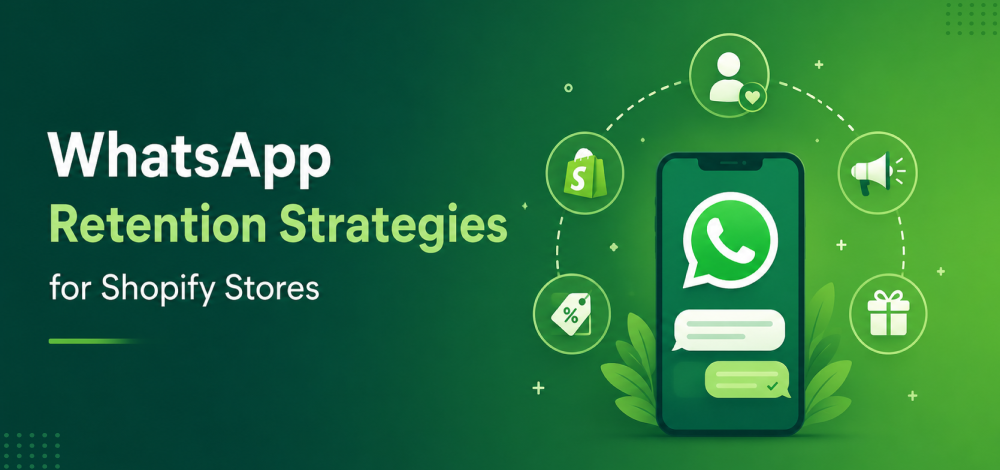
Retention starts the moment an order is confirmed. Most Shopify stores send one confirmation email and go silent. A three-stage WhatsApp sequence changes that:
- Order confirmation (immediately): confirms the purchase without the customer needing to check their email — order number, item, and estimated delivery window.
- Dispatch notification (when the order ships): proactively sends tracking information before the customer asks for it. Proactive WhatsApp order updates eliminate the majority of WISMO queries before they’re sent.
- Post-delivery check-in (7–10 days after delivery): a short, personal message before moving to a product recommendation.
This message is far more likely to receive a reply than an email equivalent because the customer is already in a WhatsApp conversation. For setting up the automated notifications that power this sequence, the WhatsApp auto reply message guide covers the full configuration.
WhatsApp Behavioral Triggers for Repeat Purchases
Triggered messages outperform scheduled campaigns because they arrive at the moment of highest intent. Three triggers drive the most repeat purchases:
- Abandoned cart messages: sent 30–60 minutes after abandonment, asking if the customer had a question rather than pushing a discount. The full setup is in the WhatsApp abandoned cart recovery guide.
- Replenishment reminders: for consumable products — skincare, supplements, food — a WhatsApp message when the customer is likely running low drives reorders without them needing to remember. Timing is based on the average usage period after the previous order.
- Browse abandonment follow-up: a customer visits a product page multiple times without purchasing. A WhatsApp message referencing the specific product, with a direct link and an offer to answer questions, reaches a customer who has expressed intent but hasn’t committed.
Personalized WhatsApp Offers for Repeat Customers
Personalised messages outperform generic campaigns on every retention metric. Three approaches that work without over-reliance on discounts:
Cross-sell based on purchase history:
Upsell based on order value:
Loyalty recognition for repeat buyers:
Each message is specific and grounded in what the customer has actually done. None of them require a formal loyalty points system.
WhatsApp Broadcast Campaigns for Shopify Retention
Broadcast campaigns are the one WhatsApp retention tool that can damage retention when overused. Customers who receive too many broadcast messages opt out — and an opted-out customer is lost from the WhatsApp channel entirely.
Broadcasts work at specific, genuinely relevant moments:
- Product launches for customers who’ve bought in that category before
- Seasonal campaigns tied to a real event
- Loyalty-specific announcements to a defined segment, not the full list
The test before sending: would this specific customer find this message relevant? If yes for the whole list, broadcast. If yes for only a segment, send it only to that segment.
WhatsApp Retention Examples for Shopify Stores
These four scenarios show how WhatsApp addresses the most common Shopify retention problems, what the specific action is, and what outcome it produces.
| Retention Challenge | Root Cause | WhatsApp Action | Expected Outcome |
|---|---|---|---|
| Customers buy once and don’t return | No post-purchase communication | Post-delivery check-in + product recommendation at day 7–10 | Higher repeat purchase rate from first-time buyers |
| Inactive customers (60–90 days) | No re-engagement trigger | Personalised win-back message with relevant product recommendation | Reactivated customers without heavy discounting |
| High WISMO query volume | No proactive order updates | Automated dispatch and delivery notifications via WhatsApp | Fewer support tickets, faster resolution |
| Low AOV from repeat buyers | Generic offers to all customers | Segment-specific cross-sell messages based on purchase history | Higher average order value from returning customers |
Retention also improves when feedback is actively collected. Short WhatsApp feedback requests sent 7–10 days after delivery get higher response rates than email surveys. Feedback data identifies experience gaps before they show up as public reviews.
Common Customer Retention Mistakes on Shopify
Retention fails in predictable ways. Avoiding these five mistakes is as important as running the right campaigns.
Sending too many promotional messages: customers who feel contacted only when there’s something to sell don’t feel valued. The ratio of useful messages to promotional ones matters.
Treating all customers the same: a VIP buyer receiving the same new-customer welcome message is a retention failure. Segmentation isn’t optional — it’s what makes retention campaigns relevant enough to work.
Relying only on discounts: retention built on discount offers creates price-sensitive customers who only return when there’s a deal, not loyal customers who return because they trust the brand.
Ignoring customer replies on WhatsApp: an automated retention message that gets a reply and goes unanswered damages retention. WhatsApp automation only works if the support infrastructure can handle the conversations it opens. For the support setup that handles replies correctly, the WhatsApp customer support guide for Shopify covers the full team and automation structure.
Stopping after the first re-engagement success: a win-back campaign that brings a dormant customer back is only the start. A customer who returns once and then hears nothing again will lapse at the same rate.
Final Thoughts
Shopify customer retention isn’t a single campaign or a one-time setup — it’s a system. The stores with the highest repeat purchase rates have a consistent post-purchase sequence, a segmented approach to different customer types, and a feedback loop that identifies experience gaps before they become churn.
WhatsApp is the delivery channel that makes each of those elements more effective — not because it replaces email, but because it reaches customers at the moments email doesn’t, in a format that invites response rather than discouraging it.
Chatix connects the WhatsApp Business API directly to your Shopify store, running the post-purchase sequence, segment-based automation, and win-back campaigns described in this guide — automatically, from your Shopify customer and order data, without manual list management.
Frequently Asked Questions
What is customer retention in Shopify?
Customer retention in Shopify is the percentage of customers who make more than one purchase. The most useful measure is repeat purchase rate: (customers with 2+ orders ÷ total customers) × 100.
What is a good Shopify customer retention rate?
Based on industry benchmarks, a repeat purchase rate of 20–30% is workable for most Shopify stores. Above 30% is strong for non-subscription ecommerce. Subscription-based businesses typically run higher.
How do I calculate my Shopify retention rate?
Use the formula [(E − N) ÷ S] × 100, where S = customers at the start of the period, E = customers at the end, and N = new customers acquired. Track quarterly for a reliable trend.
Which WhatsApp messages improve Shopify customer retention most?
Post-delivery check-ins (7–10 days after delivery) and win-back messages (60–90 days after last order) consistently produce the strongest repeat purchase results. The check-in works because it’s personal and timely. The win-back works because it reaches customers before they’ve fully disengaged.
How long does retention marketing take to show results on Shopify?
Post-purchase and cart recovery flows show measurable results within the first week. Win-back campaigns typically show results within 30–60 days. Broader retention rate improvement compounds over 3–6 months as more customers move through the full cycle.