



How WhatsApp Improves the Customer Experience at Every Stage of the Shopify Buyer Journey
Customer Support Published: January 13, 2024
For Shopify stores, WhatsApp customer experience is no longer just about answering queries faster. It’s about what the customer feels at every stage of buying — before they place an order, while they’re waiting for it, when something goes wrong, and when they decide whether to buy again.
The operational side of WhatsApp support — setup, automation, and workflows — is covered in the WhatsApp customer support guide for Shopify. This guide sits alongside it, covering what those operations produce for the customer: what a Shopify shopper actually experiences at each touchpoint when WhatsApp is done well, and why that experience determines whether they come back.
Quick Answer
WhatsApp improves customer experience for Shopify shoppers by making every support touchpoint faster, more personal, and more conversational than email or phone. A pre-purchase question gets answered in minutes while the customer is still deciding. A shipping update arrives before the customer has to ask. A return request gets resolved in a real-time conversation, not a ticket thread. Each of these moments — handled well on WhatsApp — produces a different emotional outcome than the same moment handled on email: less anxiety, more trust, and a customer more likely to order again.
Key Takeaways
- The customer experience difference between WhatsApp and email isn't speed alone — it's the format. A conversational reply feels human. A ticket confirmation doesn't
- Pre-purchase questions answered on WhatsApp while the customer is still on the product page convert at far higher rates than the same question answered by email hours later
- Post-purchase WhatsApp updates reduce the anxiety window — customers who know where their order is without having to ask feel differently about the brand than customers who have to chase
- A return handled in a real-time WhatsApp conversation preserves the customer relationship in a way that an email ticket thread rarely does
- WhatsApp analytics — read rates, response time data, re-contact frequency — are the most direct signal available to a Shopify merchant about whether their CX is actually working
Why Customer Experience on WhatsApp Feels Different
What Customers Actually Feel When They Message a Business on WhatsApp
When a customer messages a business on email, the experience is transactional from the first moment. They write a formal-ish message, they receive a ticket number, they wait. The structure of email — with its subject lines, salutations, and thread format — signals that this is official correspondence, not a conversation.
When a customer messages the same business on WhatsApp, something different happens. They're in the same app they use to message friends and family. The format is casual and conversational. A reply that arrives in minutes feels like someone is actually there. The same information — "your order is on its way, here's the tracking link" — lands differently when it arrives as a WhatsApp message than when it arrives as an email notification, because the channel itself carries an expectation of immediacy and attention.
This isn't a minor psychological detail. For a Shopify store competing on customer loyalty in a market where product differences are often marginal, how the customer feels during a support interaction is often what determines whether they buy again — not what the resolution actually was.
Why WhatsApp Outperforms Email at Every CX Touchpoint
The specific advantages aren't just open rates, though those matter. WhatsApp messages reach 90–98% open rates versus email's 20%, and they're read within minutes versus hours for email.
The deeper difference is what each channel communicates about the relationship. Email communicates process — there's a system handling your query. WhatsApp communicates presence — there's a person available to help you. Even when the WhatsApp reply is automated, the format feels more immediate than a ticket email with a case number and a 24-hour SLA disclosure.
For Shopify merchants specifically, WhatsApp's mobile-native format matters because the customer journey is increasingly mobile. A customer browsing a Shopify store on their phone, who has a question, who taps a WhatsApp button and gets a reply in three minutes — never leaves the mobile experience. The same customer who fills a contact form and waits for an email does.
Stage 1 — Pre-Purchase: When a Customer Has a Question Before They Buy
What Happens When a Pre-Purchase Question Goes Unanswered
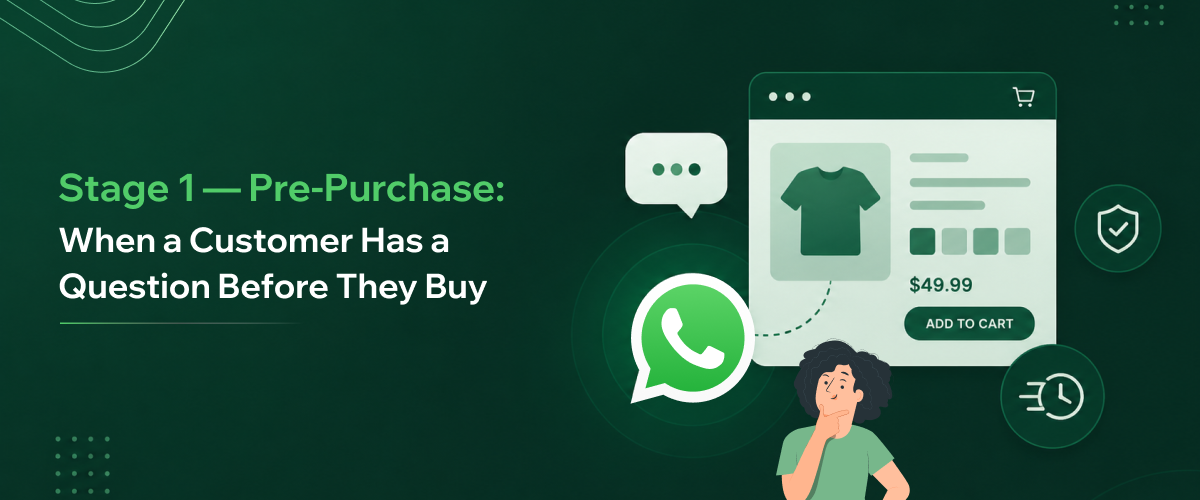
A customer on a Shopify product page with an unanswered question is a customer at the highest-risk moment in the buying journey. They've already found the product. They've already decided they want it in principle. The only thing standing between them and a purchase is a specific uncertainty — the right size, the delivery window to their location, whether a colour variant is available, whether returns are easy enough to justify the risk.
If that question gets answered within the session they're already shopping in, the conversion rate is high. If it requires leaving the product page, filling a form, and waiting for an email, most customers don't wait. They close the tab or buy from a competitor who answered faster — often while the original store's support team is still composing a reply.
What Good Pre-Purchase WhatsApp CX Looks Like
A pre-purchase WhatsApp conversation done well has three characteristics. It's fast — the reply arrives while the customer is still in buying mode, not hours after. It's specific — the agent knows the product and gives a direct answer rather than a policy link. And it closes the loop — "Would you like me to send you the direct link to the [specific size/colour]?" — moving the customer from answered question to completed purchase.
The WhatsApp button placement matters here. A button on the product page, with a pre-filled message that references the specific product the customer is looking at, starts the conversation in context. A floating button on the homepage with a generic greeting message starts it from scratch.
For the greeting message that customers see when they click that button for the first time, the WhatsApp business greeting message guide covers what to write and how to set it up.
Stage 2 — Post-Purchase: The Most Underused CX Window in Shopify
Order Confirmation and Shipping Updates — What Customers Notice
The period between placing an order and receiving it is the highest-anxiety window in the Shopify customer journey. Most stores treat it as dead air — a confirmation email goes out, a dispatch email goes out, and the customer is left to track the order themselves and wonder when it arrives.
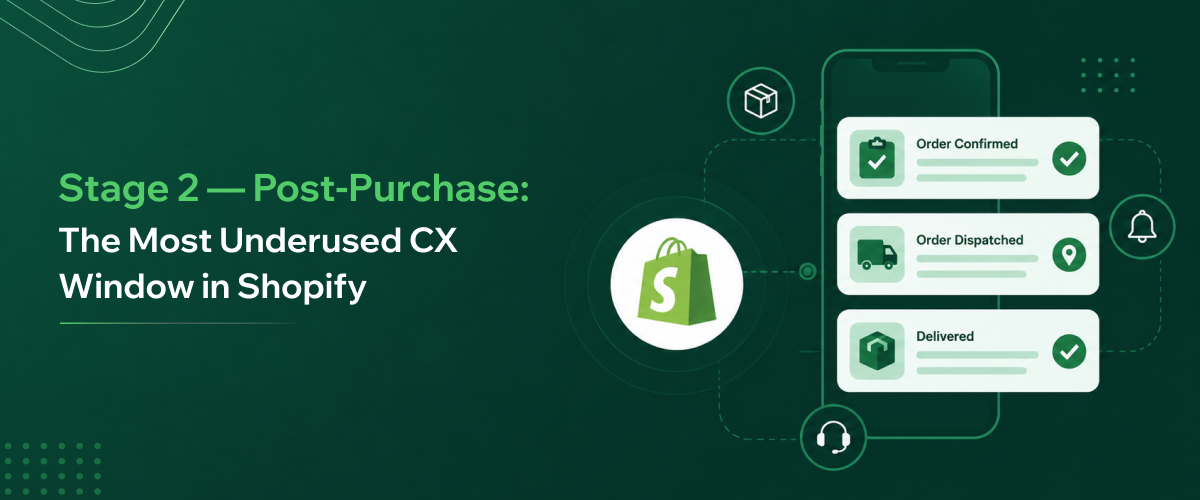
What customers notice when post-purchase WhatsApp communication is done well: they don't have to wonder. An order confirmation arrives on WhatsApp within seconds of placing the order — the customer knows the order is confirmed without checking their email. A dispatch message arrives when the order ships — with a tracking link that opens the courier's app directly from WhatsApp. A delivery confirmation message arrives after the order is marked delivered.
Each of these messages costs the Shopify merchant almost nothing to send. Each one removes a specific anxiety spike the customer would otherwise have felt — and those anxiety spikes, left unresolved, generate WISMO messages that cost agent time. Proactive WhatsApp updates don’t just improve CX — they reduce the support volume that would otherwise arrive later. For how to set up the automated notification and away messages that power this, the WhatsApp auto reply and notification setup guide covers the full process.
The COD Experience — Why Confirmation Messages Change Customer Confidence
For Shopify customers who pay cash-on-delivery — particularly in India and South Asia where COD represents a significant share of ecommerce orders — the post-purchase experience has a specific anxiety layer that prepaid orders don't: uncertainty about whether the business actually received the order and will actually dispatch it.
A COD confirmation message on WhatsApp — arriving within minutes of the order being placed, asking the customer to confirm they placed the order and will be available for delivery — does two things simultaneously. It gives the customer certainty that the order is being processed. And it gives the merchant the customer's active confirmation, reducing fake orders before they cost anything to fulfil.
From the customer's perspective, a COD WhatsApp confirmation feels like a professional, attentive business. The alternative — silence until a delivery attempt arrives — leaves customers uncertain whether the order was received at all.
For the exact message flow, timing, and Shopify setup that makes this happen automatically, the WhatsApp COD verification for Shopify guide covers the complete workflow.
Stage 3 — Issue Resolution: How WhatsApp Changes the Way Complaints Feel
Why WhatsApp Makes Returns and Refunds Feel Less Painful
A customer filing a return or refund request is a customer in a moment of friction. The product didn't meet expectations. Something went wrong. The experience they have during the resolution process — not just the resolution itself — determines whether they buy from that store again.
On email, a return request feels like a complaint being logged. The customer writes a formal message, receives a confirmation that their request has been received, and waits for a human to process it through a system. Even when the refund comes through quickly, the experience feels cold and procedural.
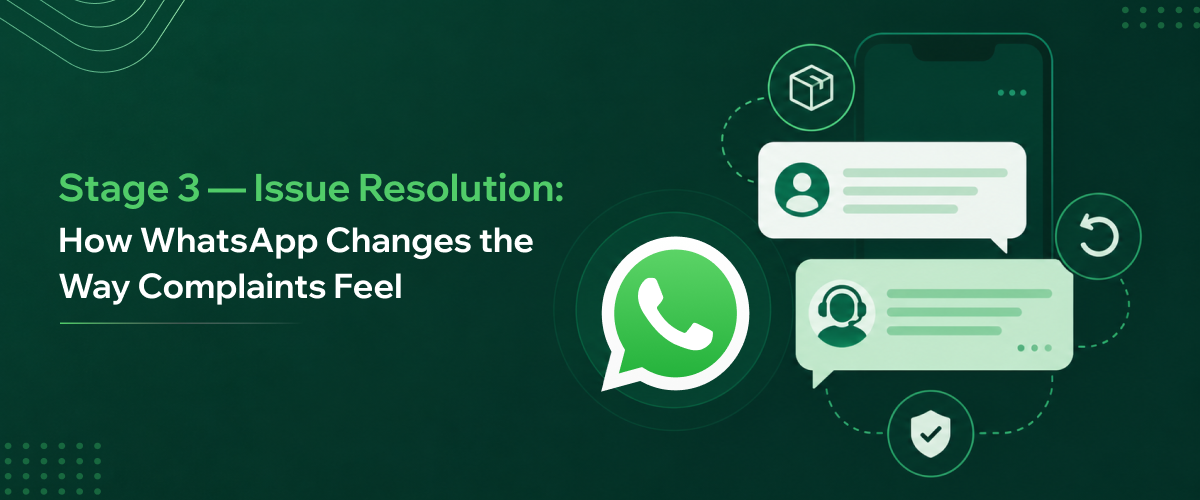
On WhatsApp, the same conversation can feel like a person helping another person sort something out. An agent who replies within minutes, acknowledges the problem directly, sends the return label in the same conversation, and follows up to confirm the customer received it — that sequence produces a different emotional outcome than an identical resolution handled through email tickets. The customer's feeling walking away is that the brand cared, not that the brand processed their complaint correctly.
For the specific tone and workflow that makes WhatsApp complaints resolve better, the WhatsApp customer support tips guide covers the tone-matching approach that changes how customers experience issue resolution.
The Speed Factor — What a 3-Minute Reply Does vs a 3-Hour One
Response time is the most measurable variable in WhatsApp CX, and the difference between a fast and slow response isn't proportional — it's categorical.
A customer with a delivery complaint who receives a reply in 3 minutes is still in the emotional state they were in when they sent the message. They're frustrated, but the frustration is fresh and manageable. An agent who acknowledges it immediately and moves to resolution catches the customer before that frustration has time to compound into anger or a decision to leave a review.
The same customer, three hours later, is in a different state. The frustration has had time to sit. They may have told someone else about the problem. They may have already decided this was the last time they'd order from this store. A technically identical resolution — same outcome, same refund, same apology — lands completely differently after a three-hour wait than after a three-minute one.
For Shopify stores, this is why first response time is the single most important WhatsApp CX metric to measure and optimise — not resolution quality, not message content, but the time between the customer's message and the first human reply.
Stage 4 — Retention: Why Good WhatsApp CX Brings Customers Back
The Post-Delivery Follow-Up — What It Signals to the Customer
Most Shopify stores go silent after a successful delivery. The transaction is complete, the money is in, the product is with the customer. There's no operational reason to send another message.
But from the customer's perspective, a brief WhatsApp check-in after delivery — "Hope your order arrived okay. Let us know if anything wasn't right." — signals something that very few brands do: that the relationship extends past the transaction. The customer is not just a completed order.
This signal is disproportionately powerful because the bar is so low. Most brands don't send it. The customers who receive it notice. And customers who feel noticed are more likely to come back, more likely to recommend, and more likely to give honest feedback when something isn't right — which is more useful to the business than a negative review posted after they've already decided not to return.
For ready-to-use post-delivery check-in and feedback request messages — including different variations based on order type and customer history — the WhatsApp feedback message templates guide has a full set.
How Support Quality on WhatsApp Affects Repeat Purchase Behaviour
The connection between WhatsApp CX quality and repeat purchase rate is one of the clearest measurable relationships in Shopify ecommerce. Customers who had a support interaction on WhatsApp that resolved well — quickly, personally, and with genuine attention — repurchase at rates comparable to or above customers who never needed support at all.
Customers who had a poor support experience — slow replies, impersonal responses, unresolved issues — churn at a rate higher than customers who never contacted support, because they now have an active negative experience to weigh against the product itself.
This is why the measure of WhatsApp CX success is not customer satisfaction scores during the interaction — it's repeat purchase rate among customers who had a support interaction. That number is the most honest signal of whether WhatsApp is doing what it should for the business.
For how WhatsApp fits into the broader customer retention picture, the retention marketing guide covers the full repeat-purchase lifecycle.
What WhatsApp Analytics Tell You About Your Customer Experience
The 4 Metrics That Show Whether Your WhatsApp CX Is Working
WhatsApp generates four data points that, read together, tell a Shopify merchant whether their customer experience is actually improving — not in theory, but in practice.
Message read rate — the percentage of WhatsApp messages the customer opens. A high read rate (90%+) confirms the message reached the customer. A sudden drop in read rate on a specific message type — shipping notifications, for example — suggests the message is arriving at the wrong time, with the wrong content, or to a segment that isn't engaged.
First response time — how quickly the first human reply reaches the customer after they message. This is the most direct proxy for how the customer experiences the support interaction. A store consistently hitting under 5 minutes during business hours is producing a fundamentally different CX than a store averaging 3 hours.
Re-contact rate — the percentage of customers who message again about the same issue within 48 hours. A high re-contact rate means conversations are being closed before the issue is actually resolved. The customer thought the problem was being handled; it wasn't.
Repeat purchase rate for supported customers — the most important metric. Customers who had a support interaction on WhatsApp should repurchase at or above the store baseline. If they churn at a higher rate than customers who never contacted support, the support interaction is losing the relationship rather than preserving it.
How to Use WhatsApp Data to Identify CX Gaps
Each metric points to a specific type of CX gap when it underperforms.
A low read rate on post-purchase messages could suggest the messages are arriving outside the customer’s active window, that message quality or content needs reviewing, or that opt-in health needs checking — customers who didn’t actively opt in tend to mute or ignore messages at higher rates.
A high first response time during business hours points to either understaffing for the message volume coming in, or agents managing conversations without triage — handling low-urgency messages before high-urgency ones.
A high re-contact rate on specific query types — returns, for example — suggests the quick replies or agent responses for that query type aren't complete. The customer is leaving the conversation with a partial answer.
A low repeat purchase rate among supported customers is the most serious signal — it means the CX during the support interaction is actively losing customers who would otherwise have come back. It warrants an audit of the specific conversations where customers churned: what was the first response time, what was the tone, was the issue resolved on first contact.
Final Thoughts
Customer experience on WhatsApp isn’t a feature of WhatsApp — it’s a result of how intentionally each touchpoint is handled. A fast greeting message, a proactive shipping update, a returns conversation that acknowledges the problem before solving it, a post-delivery check-in that most brands never send — none of these are technically complex. All of them are felt by the customer.
The stores that do this well aren’t distinguished by their tools. They’re distinguished by how consistently they show up for the customer at each of these moments — before the purchase, through the delivery, when something goes wrong, and after the order arrives.
Chatix connects the WhatsApp Business API directly to your Shopify store — giving your team the shared inbox, order context, and automation to deliver the customer experience described in this guide, from pre-purchase questions through post-delivery follow-ups, from one dashboard.
Frequently Asked Questions
1. How does WhatsApp improve customer experience compared to email?
WhatsApp replies arrive faster, feel more personal, and keep the customer in a mobile-native conversation rather than an email thread. The same resolution delivered on WhatsApp in 3 minutes produces a better customer outcome than the same resolution delivered by email in 3 hours.
2. How can WhatsApp analytics improve customer experience?
Four metrics directly signal CX quality: message read rate (are customers seeing messages), first response time (how fast support arrives), re-contact rate (whether issues are actually resolved), and repeat purchase rate among supported customers (whether the interaction preserved the relationship).
3. What is the WhatsApp customer experience for a Shopify shopper?
A Shopify customer using WhatsApp can get pre-purchase questions answered before they complete an order, receive proactive shipping updates without having to ask, resolve issues in real-time conversation, and receive a post-delivery follow-up — all in the same app they use for everyday messaging.
4. Does good WhatsApp customer experience lead to more repeat purchases?
Yes — customers whose support interactions on WhatsApp resolved quickly and personally repurchase at rates comparable to or above customers who never needed support. Customers with poor support experiences churn at higher rates.
5. How quickly should I respond to WhatsApp messages to improve customer experience?
Under 5 minutes during business hours is the standard for WhatsApp. Above 2 hours, customer satisfaction drops regardless of how good the eventual response is.