


Is WhatsApp Marketing Actually Effective? A Real Comparison for Shopify Stores
WhatsApp Marketing Published: July 07, 2025
Merchants who are already getting results from email, SMS, or paid ads have a legitimate reason to question whether adding WhatsApp is worth the time and setup cost. That is a fair position. WhatsApp marketing gets a lot of hype — and like anything surrounded by hype, it deserves a straight answer backed by actual data.
The honest answer depends on what you are measuring and who your customers are. WhatsApp is the most effective direct marketing channel for opted-in customers in high-penetration markets — India, the Middle East, Brazil, Southeast Asia. For a Shopify brand selling primarily to US or Canadian customers over 50, the picture is different.
This comparison uses 2026 data across five dimensions — reach, cost, speed, rich media, and automation — to give a clear verdict. The goal is not to sell you on WhatsApp. The goal is to help you make an informed decision about where to put your marketing effort.
Quick Answer
WhatsApp marketing outperforms traditional marketing on every measurable engagement metric — open rate (98% vs 20% for email), CTR (50%+ vs 1-4% for email), response rate (55%+ vs under 10%), and conversion rate (45-60% vs 5% for email). Traditional channels retain genuine advantages in brand awareness at scale, reaching offline demographics, and markets where WhatsApp penetration is low. For most Shopify D2C merchants in India and the Middle East, WhatsApp should be the primary direct marketing channel — not a supplement.
Key Takeaways
- WhatsApp messages have a 98% open rate vs email's 20% — and 88% of WhatsApp messages are read within 5 minutes of delivery. Email open rates of 20% mean 8 out of 10 customers never see your message.
- WhatsApp conversational commerce converts at 45–60% — 12× higher than traditional channels, according to 2026 industry benchmarks.
- Click-to-WhatsApp ads deliver 92% lower cost per lead — compared to traditional paid acquisition, making them the most efficient acquisition format available in 2026.
- Traditional marketing still wins in 4 specific scenarios — brand building at scale, offline demographics, low-WhatsApp markets (US, Canada, Northern Europe), and credibility signalling through major publications.
Is WhatsApp Marketing Actually Effective? What the 2026 Data Shows
This is the question most merchants ask before committing budget or setup time to a new channel. The answer is yes — with one important condition. WhatsApp marketing is highly effective for opted-in contacts in markets where the platform dominates. The data below covers the strong numbers and the caveats that matter for Shopify merchants.
| Metric | SMS | Print / TV | ||
|---|---|---|---|---|
| Open rate | 98% | 20–25% | 90%+ | Not trackable |
| Click-through rate | 50%+ | 1–4% | 25% | Not trackable |
| Response rate | 55%+ | Under 10% | 28% | Not trackable |
| Messages read in 5 mins | 88% | N/A | N/A | N/A |
| Conversion rate | 45–60% | 5% | N/A | N/A |
| Revenue per recipient | 1.7× email | Baseline | — | — |
Conversion rates in WhatsApp conversational commerce run at 45–60% — 12× higher than traditional channels. For a Shopify merchant sending an abandoned cart reminder, that speed advantage is the entire difference between recovering a sale and losing it. For ecommerce brands, this performance is especially relevant when running targeted WhatsApp marketing campaigns for promotions, product launches, abandoned carts, and customer retention.
An email sent 30 minutes after cart abandonment reaches the customer when they eventually open their inbox — often hours later, often under 40 other unread messages. A WhatsApp message arrives in the app they are already in and gets read in under 5 minutes. Shopify merchants can take this further with WhatsApp abandoned cart recovery, where the message is triggered automatically after a customer leaves checkout.
The condition that limits WhatsApp's effectiveness is opt-in dependency. WhatsApp requires explicit consent before any marketing message can be sent — and that list has to be built from zero. A Shopify store with no WhatsApp subscribers cannot run a single campaign. Traditional channels, paid ads, and email do not require opt-in at the same level. The ROI advantage of WhatsApp becomes clear at 500+ opted-in contacts. Before that threshold, the setup investment outweighs the return.
WhatsApp vs Traditional Marketing: A Quick Definition of Each
Before comparing across five dimensions, it helps to be precise about what each channel actually covers — because "traditional marketing" means very different things depending on the business.
What WhatsApp Marketing Covers
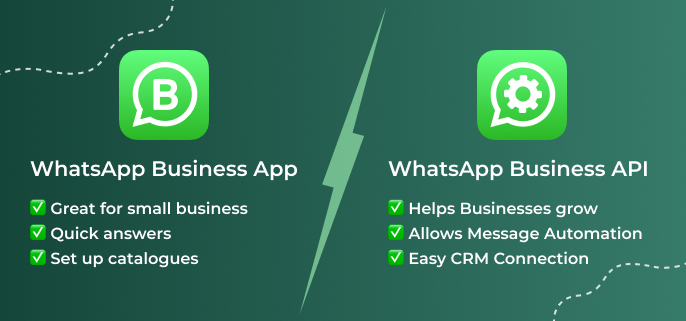
WhatsApp marketing uses the WhatsApp Business App (for small stores, free, limited to 256 contacts per broadcast) or the WhatsApp Business API (for automation, Shopify integration, and unlimited broadcast to opted-in contacts) to send direct messages, run campaigns, and automate post-purchase flows. It covers everything from product launches and flash sales to abandoned cart recovery and order confirmations — all in one conversational channel. For the full strategy framework, see the WhatsApp marketing guide.
What Traditional Marketing Covers
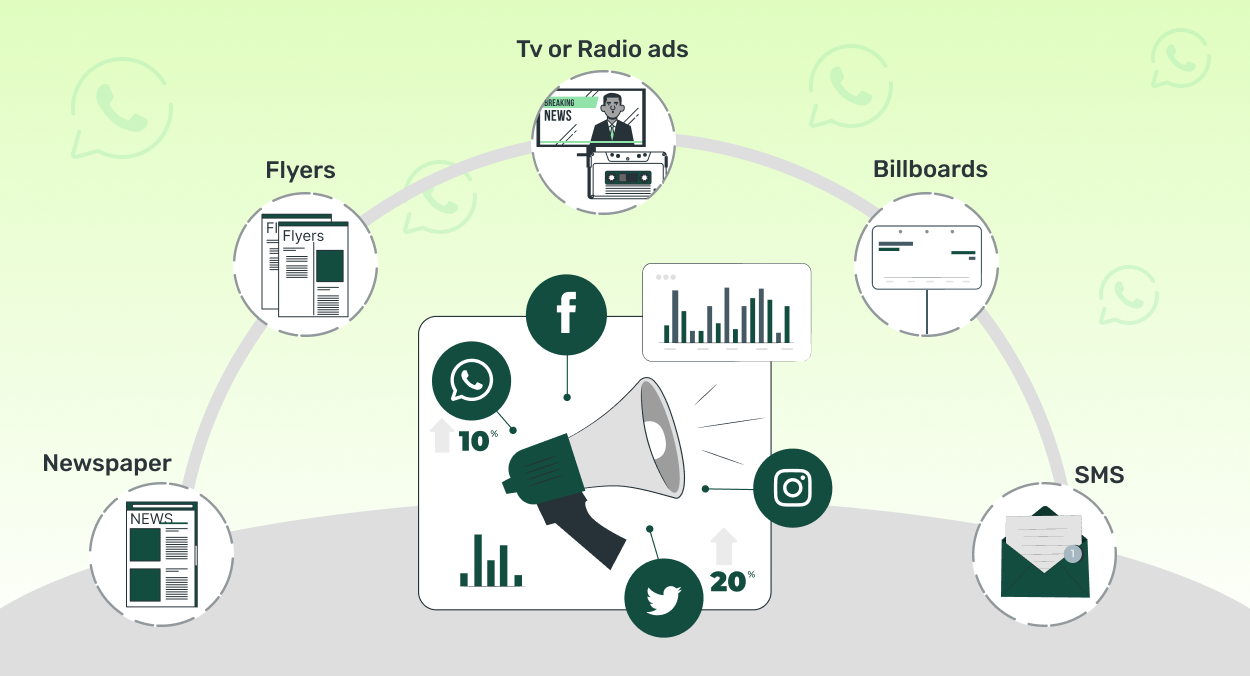
Traditional marketing refers to offline and push-based digital channels — TV commercials, radio, print advertising, billboards, direct mail, SMS blasts, and email campaigns. The defining characteristic of traditional marketing is one-way communication: the brand sends, the customer receives, and two-way interaction is either absent or heavily delayed. This is not a criticism — one-way broadcast at massive scale is exactly what traditional marketing is designed for, and it does that job well. The limitation is that it does that job at significant cost with no real-time feedback loop.
WhatsApp vs Traditional Marketing Across 5 Dimensions
These five dimensions are the ones that directly affect revenue, cost, and customer relationships for a Shopify merchant — not theoretical brand metrics, but practical performance data.
Reach and Open Rate
WhatsApp achieves a 98% open rate — far surpassing email's 20% average. CTRs on WhatsApp campaigns exceed 50%, while SMS averages 25% and email sits between 1-4%. The response rate on WhatsApp exceeds 55%, while SMS remains at 28% and email under 10%.
The reach comparison for traditional marketing is less about whether the message is seen and more about whether it can be measured. A Shopify merchant spending ₹2 lakh on a print catalogue has no way of knowing how many people opened it, responded to it, or remembered the brand name two days later. WhatsApp gives you open rate, read rate, click rate, and conversion rate per message — per recipient. That difference in measurability alone changes what it means to "reach" a customer.
Cost and ROI
WhatsApp Business API pricing in India runs at approximately ₹0.50 to ₹2.50 per conversation depending on BSP, message category, and volume. If you're evaluating whether the API is worth the setup cost, the WhatsApp Business API for Shopify guide explains what it unlocks for growing stores and what you need before applying. Click-to-WhatsApp ads on Meta deliver 92% lower cost per lead compared to traditional paid acquisition — the most cost-efficient acquisition format available in 2026.
The honest counterpoint: WhatsApp API has real setup costs. BSP fees, template approval time, and the effort required to build an opt-in list from zero are genuine upfront investments. For a brand-new Shopify store with under 100 customers, starting with email and building toward WhatsApp is a more realistic path than expecting WhatsApp to replace paid acquisition from day one. The ROI advantage compounds as the opted-in list grows.
Traditional channels — full-page newspaper ads, TV spots, SMS blast campaigns — carry significantly higher per-reach costs with no tracking and no personalisation. The cost efficiency of WhatsApp scales with list size; traditional costs scale with distribution volume regardless of engagement.
Speed and Flexibility
WhatsApp allows a Shopify merchant to create a flash sale campaign in under 10 minutes, change a template the same day a supplier raises prices, and receive customer replies within minutes of sending. Traditional marketing operates on production timelines measured in days to weeks — TV and radio require scripting, production, and booking; print requires design, proofing, and printing lead times.
Traditional marketing pushes messages. WhatsApp pulls customers into conversations. In an industry where a Shopify merchant needs to respond to a competitor's sale or an unexpected stock situation in real time, WhatsApp is the only direct channel that moves at business speed. The flexibility to act on new information immediately is a structural advantage that no traditional channel can close.
Rich Media and Interactive Content
WhatsApp supports images, video, PDF documents, voice notes, clickable buttons, quick reply options, shopping catalogues, and WhatsApp Flows for in-chat checkout — all within the same message thread. For a Shopify merchant, this means the entire post-purchase communication stack (order confirmation, tracking update, review request, reorder reminder) runs in one channel with full interactivity and measurement.
Traditional marketing's richest format — a full-page glossy magazine ad — offers exactly one direction of communication. The customer sees the ad. They cannot reply to it, click a button inside it, or complete a purchase without leaving the medium entirely. WhatsApp's interactive formats convert the message itself into a mini-storefront.
Automation and Integration for Shopify Stores
WhatsApp Business API integrates directly with Shopify through BSPs — abandoned cart triggers fire when a checkout is started but not completed, restock alerts fire when inventory is updated from zero, and review requests fire automatically on the seventh day after delivery. Chatix connects to Shopify natively and manages this automation without requiring custom development or engineering support. For a deeper look at the workflows available, see the WhatsApp automation for Shopify guide.
| Dimension | WhatsApp Marketing | Traditional Marketing |
|---|---|---|
| Open rate | 98% | Not trackable (print/TV) / 20% email |
| Click-through rate | 50%+ | 1–4% (email) / 25% (SMS) |
| Response rate | 55%+ | Under 10% |
| Cost per interaction | ₹0.50–2.50 per conversation | High and largely untrackable |
| Real-time adjustment | Yes — same day | No — days to weeks |
| Shopify native integration | Yes via API | Limited |
| Opt-in requirement | Required for all contacts | Varies by channel |
| Two-way communication | Yes — real-time | No |
| Rich media support | Images, video, buttons, flows | Static (print) or one-way (TV/radio) |
Where Traditional Marketing Still Wins — The Honest Answer
WhatsApp does not win every comparison. There are four specific scenarios where traditional channels outperform WhatsApp or are simply more appropriate — and knowing which of these applies to your business prevents a costly mistake in channel strategy.
- Brand building at scale — For awareness campaigns targeting millions of people who have never heard of your brand, TV and outdoor advertising reach audiences that no opt-in WhatsApp list ever will. WhatsApp only reaches people already in your subscriber base. Traditional channels reach anyone within broadcast range. A Shopify brand launching in a new city gets faster name recognition from a well-placed billboard or radio spot than from a WhatsApp campaign to 500 subscribers.
- Older and offline demographics — If your Shopify store primarily sells to customers over 60, or to rural markets where smartphone penetration is limited, WhatsApp adoption may not match your audience. Traditional channels — local newspaper, radio, physical flyers — are more reliable for this segment and should not be abandoned in favour of a channel your customers do not use.
- Low-WhatsApp-penetration markets — In the United States, Canada, and most of Northern and Western Europe, WhatsApp is not the dominant messaging app. Instagram DM, iMessage, and email hold far larger market share in these regions. If your Shopify store's primary customer base is US or Canadian, email and SMS will significantly outreach WhatsApp for the same effort. India, Brazil, Indonesia, and the Middle East are a fundamentally different situation.
- Trust and credibility signalling — A mention in a major national publication or a television appearance still carries authority that a WhatsApp broadcast cannot replicate. For early-stage Shopify brands trying to establish credibility with a new audience, a strategic traditional media placement can shift brand perception in a way that no opt-in messaging campaign achieves. WhatsApp marketing excels at converting trust that already exists — it is not the best channel for building trust from zero.
Which Should You Choose for Your Shopify Store?
For most Shopify merchants, this is not an either/or decision. The question is which channel to prioritise, where to invest first, and what role each one plays in the marketing mix. For stores building an opted-in audience, WhatsApp broadcast messages can then be used for promotions, product launches, restock alerts, and seasonal campaigns.
Choose WhatsApp Marketing as Your Primary Direct Channel If:
- Your customers are primarily in India, the Middle East, LATAM, or Southeast Asia — where WhatsApp is the default communication app and most smartphone users check it daily
- Your store does more than 50 orders a month — at which point automating cart recovery, review requests, and restock alerts on WhatsApp has a clear positive return on setup cost
- You need real-time conversion (abandoned cart, restock alerts) — WhatsApp recovers these at 3–7× the rate of email in markets where the platform is dominant
- Your product has a short consideration cycle — fashion, beauty, supplements, food — where a well-timed WhatsApp message closes a sale that email would have lost to inertia
Consider Keeping Traditional Channels If:
- Your target market is primarily the US, Canada, or Northern Europe — where email and SMS reach more customers than WhatsApp for the same marketing effort
- Your brand is in its early stages and needs awareness from new audiences — traditional media reaches people who have not opted in to anything yet; WhatsApp cannot
- Your customers skew older or less smartphone-dependent — in which case traditional channels are not outdated — they are the right tool for the audience
The Right Answer for Most Shopify Stores Selling in India
Most Shopify merchants reading this are selling in India or in markets where WhatsApp penetration is above 70%. For them, the verdict is clear: set up WhatsApp marketing infrastructure first — build the opt-in list through checkout, run automations (cart recovery, restock, post-purchase) before spending anything on traditional channels. Traditional marketing can run in parallel once the WhatsApp foundation is stable, but it should not come first in the budget or the timeline.
For managing this inside Shopify without custom development, Chatix handles the full API setup, opt-in collection, and automation configuration directly within your Shopify store. For the most common mistakes merchants make when starting WhatsApp marketing, review this guide before beginning.
Final Thoughts
The comparison between WhatsApp and traditional marketing is not particularly close on any measurable metric for a Shopify merchant selling in India or a high-WhatsApp-penetration market. WhatsApp wins on open rate, CTR, response rate, conversion rate, and cost efficiency — while traditional marketing retains genuine advantages only in brand awareness at scale and offline audience reach. The honest answer to "is WhatsApp marketing effective?" is yes — for opted-in customers in high-penetration markets, it is the most effective direct marketing channel available in 2026, and it is not especially close. If you are a Shopify merchant who has not yet set up WhatsApp marketing, Chatix connects to your store and has your first automation live in under 30 minutes.
Frequently Asked Questions
Is WhatsApp marketing better than traditional marketing?
For Shopify stores in India, the Middle East, and Southeast Asia — yes, on every measurable metric. Traditional marketing holds an advantage only for brand awareness at scale and reaching offline or older demographics.
What is the open rate of WhatsApp compared to email?
WhatsApp achieves a 98% open rate with 88% of messages read within 5 minutes. Email averages 20% open rate, meaning 8 out of 10 customers never see your message.
Is WhatsApp marketing cost-effective for small Shopify stores?
Yes. WhatsApp API conversations in India cost ₹0.50–2.50 each, and abandoned cart recovery alone typically covers the monthly BSP cost within the first two weeks.
Does WhatsApp marketing work without an existing subscriber list?
No — you need opted-in contacts first. A checkout opt-in checkbox typically builds 500+ contacts within 30–45 days, which is the minimum threshold where WhatsApp marketing becomes cost-positive.
When should a Shopify store stick with traditional marketing?
When your audience is primarily in the US, Canada, or Northern Europe (low WhatsApp penetration), when customers are 60+, or when you need mass brand awareness beyond your existing subscriber base.
Which gives better ROI — WhatsApp or email for Shopify?
WhatsApp generates 1.7× more revenue per recipient than email for opted-in lists and converts abandoned carts at 3–7× the rate. Email remains relevant for markets where WhatsApp is not the dominant channel.
Can WhatsApp marketing replace traditional advertising entirely?
Not for new stores. WhatsApp only reaches opted-in contacts — it cannot build awareness with audiences who have never heard of your brand. Traditional channels still serve that discovery role.
Is WhatsApp marketing effective for B2C ecommerce in India?
Yes — India has 535 million WhatsApp users and it is the default communication channel. D2C brands using WhatsApp post-purchase flows see a 45% increase in repeat customer rates on average.